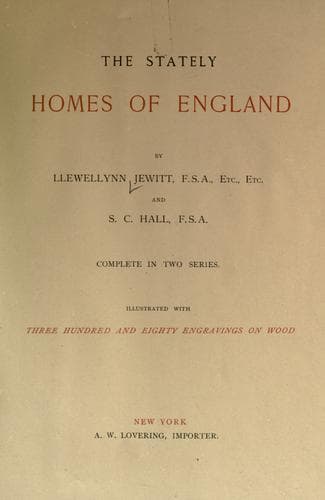
The Stately Homes of EnglandJewitt, Llewellynn Frederick William
History
The Stately Homes of England
Jewitt, Llewellynn Frederick William
Historic buildings -- England
extends to the Percy gateway, that the most gorgeous Art of the Italian
_Renaissance_, with all its manifold resources, has been taxed to the
utmost in order to produce a palace of the highest rank, pervaded
throughout with harmonious, yet ever-varied, magnificence.
[Illustration: _Hulne Abbey: The Percy Tower._]
On the ground-floor, which is on the same level with the entrance-hall,
are the various apartments, consistently grouped and classified,
required by the principal domestics of the household, together with the
wine-cellars, pantries, and such other chambers and appliances as would
be necessary to complete this department of the ducal establishment.
Once more we return to the Prudhoe Tower, and ascend above its two
upper floors of bed and dressing-rooms, to the Banner-turret, which
rises to the height of two additional floors; and here, having gained
the leads, standing beneath the proud insignia of the Percies, heavily
blazoned upon their broad silken banner, we lean over the embattled
parapet, and look down upon the Keep, and around upon the cordon of
towers and walls, and the fair domains and the silvery river beyond,
and so we bid farewell to the lordly castle of Alnwick.
Until the middle of the fifteenth century was near at hand the town of
Alnwick remained unprotected by a wall, and open consequently to all
perils incidental to its position on the Border. About the year 1433,
however, the good town was fortified with walls, and the four entrances
were defended each by its own strong tower-guarded gateway. One only of
these early gateways still remains in a fair condition of preservation;
this, the Bond Gate, sometimes (but without any other reason than a
lingering delight to associate any fine old relic at Alnwick with that
name) is called “Hotspur’s Gate.” It bears a badge of the second Percy
lord of Alnwick, and in all probability was erected by him; its outer
face is represented in the engraving.
The other gateways have disappeared;[24] and from the time that
border-strife passed into the domain of history, the walls of Alnwick
gradually ceased to exist, until now traces only of their former
existence, and of these “few and far between,” remain to attest the
record of their having ever existed. Devoutly it is to be hoped that
the one relic of the town of the olden time, the Bond Gate, will be
cherished, simply because it is such a relic—because it links the
town to the castle, and the castle to the town, with the strong tie
of historical association. Again space, or rather the want of it,
constrains us to leave unnoticed the fine church of St. Michael, the
church of St. Paul, founded and erected by Duke Hugh, and the other
public buildings in Alnwick; and, with them, the privileges, usages,
and the entire local history of the town.[25]
Public-domain text, read in full here on John Shaqi.
Reviews
Reviews
No reviews yet
Be the first to share your thoughts on this work.
Elsewhere in the archive
Join the Discussion
Join the discussion
Sign in to leave a comment or review.
Sign InorCreate an account