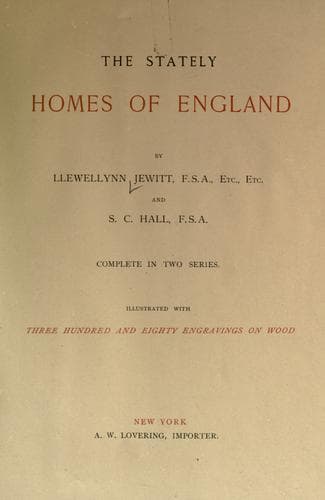
The Stately Homes of EnglandJewitt, Llewellynn Frederick William
History
The Stately Homes of England
Jewitt, Llewellynn Frederick William
Historic buildings -- England
Distant from Alnwick Abbey about two miles along the northern bank of
the Aln, and like the abbey placed in the midst of the most lovely
scenery, the Priory of HULNE, or HOLN, has so far been more fortunate
than its more dignified neighbour, that it yet possesses considerable
remains of its original buildings in a condition of picturesque ruin.
A lofty wall still encircles the entire area of the priory—a feature
sufficiently significant of the lawless character of early Border-life,
and of the stern necessity which constrained even a religious community
to rely for security upon the strength of its fortifications. In our
engraving we show the present aspect of the tower, built, as will
be seen, with massive solidity, by Henry de Percy, fourth Earl of
Northumberland, in the year 1488; and in another engraving, we give
a general view of the ruins of the church, as they are seen from the
north-east. It is pleasant to be able to add that the remains of Hulne
Priory are carefully preserved and freely shown. The brethren, who for
more than three centuries found a secure dwelling-place surrounded
with the most beautiful scenery, were Carmelite or White Friars; and
a romantic story (of which several versions are in existence) is told
concerning their order in connection with the foundation of this
priory. The site of the priory was given by the second William de Vesci
about 1240; but the chief endowment came, between 1252 and 1289, from
John de Vesci; the house itself, however, appears to have been erected
by Ralph Fulborne, a wealthy landholder of Northumberland, who lived in
the stirring times when the lords of broad and fertile acres went armed
to fight in the Holy Land against the infidels.[26] In after times the
Percies confirmed the grants of the earlier benefactors of Hulne, and
made to them some slight additions. The Carmelites of Hulne were men
who, according to the light of their times, cultivated learning; this
is shown by the still existing catalogue of the numerous manuscripts
that once formed their library. There has also been preserved another
equally curious and interesting document, formerly the property of
these Carmelite brethren; it is an inventory of their vestments and
of the fittings of their church, which must have been very costly as
well as numerous and splendid. Inventories and catalogues such as these
possess a peculiar value, as illustrations of the intellectual pursuits
and character of the monastic age, and also in consequence of the light
they throw upon the sentiments and usages that then were prevalent in
our country.
Public-domain text, read in full here on John Shaqi.
Reviews
Reviews
No reviews yet
Be the first to share your thoughts on this work.
Elsewhere in the archive
Join the Discussion
Join the discussion
Sign in to leave a comment or review.
Sign InorCreate an account