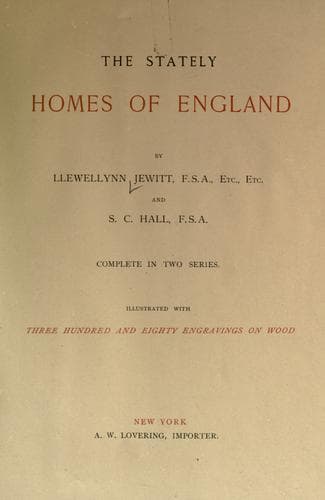
The Stately Homes of EnglandJewitt, Llewellynn Frederick William
History
The Stately Homes of England
Jewitt, Llewellynn Frederick William
Historic buildings -- England
HARDWICK HALL may take rank among the more stately of the “homes of
England.” Stately in its outer aspect, stately in its antique furniture
and its interior fittings and appointments, and truly stately in its
associations, it is one of the most historically interesting, and
one of the most singular and picturesque, of the many “homes” whose
countless stores of natural beauties and acquired treasures are,
through the kindness and liberality of their owners, made accessible
alike to peer and peasant; while it is one of the fullest in its
historical associations, and in its power of carrying the mind of the
visitor back through a long vista of years to those stirring times
when “Good Queen Bess,” the strong-minded and strong-headed “master”
of its noble owner, sate on the throne of England. Hardwick and its
surroundings belong essentially to those times, and to the people who
moved prominently in them: the very furniture we see to-day pertains to
that eventful era—for not only is the building itself of the period to
which we refer, but so are even the “fittings;” the beds—for here is
the very bed used by Mary, Queen of Scots, and covered with needlework,
the work of her own fair hands; the tables around and at which sate
“Bess of Hardwick” with her historic family and brilliant friends; the
tapestry is that which then hung around them, and on which the eyes
of royalty and nobility have rested and “feasted with admiration;”
the screens, the chairs, the couches,—nay, almost all the objects
that meet the eye are of those stirring times, and have about them an
historic air which seems irresistibly to subdue the mind and to expand
the thoughts of the visitor.
Even a _glance_ at the graces and beauties of Derbyshire would demand
far greater space than we can accord to them: for it is the shire of
all the English shires in which natural beauties are most happily
combined with cultivated graces; hill and dale alternate at every mile;
rich valleys, through which run fertilising rivers, shut in by mountain
rocks, tree-clad from base to summit; singular peaks, that seem as if
not formed by Nature, but the work of giant hands; delicious dells,
where rivulets sing perpetually, and myriad birds rejoice in spring or
summer. Other counties may be more sublimely grand, and others more
abundantly fertile, but there is none so truly rich in the picturesque;
whether of distant views or of by-paths up hill-sides, or through lanes
clothed in perpetual verdure.
And then its history, a page of which may be read at every turn—the
Celt, the Roman, the Saxon, the Dane, the Norman, all the “peoples and
nations” that have made Britain their home, have left in this shire
enduring evidence of possession and progress; and many of its customs
remain unchanged, not only since the beacons were lit on Blakelow or
on Bruncliffe, but since the Baal fires were burning on Axe-Edge or
Chelmorton.
Public-domain text, read in full here on John Shaqi.
Reviews
Reviews
No reviews yet
Be the first to share your thoughts on this work.
Elsewhere in the archive
Join the Discussion
Join the discussion
Sign in to leave a comment or review.
Sign InorCreate an account