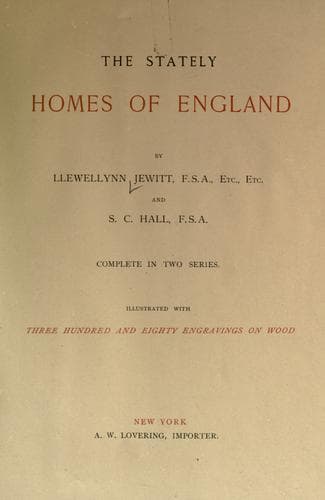
The Stately Homes of EnglandJewitt, Llewellynn Frederick William
History
The Stately Homes of England
Jewitt, Llewellynn Frederick William
Historic buildings -- England
William, fourth Duke of Devonshire, who was, during his father’s
lifetime, called to the Upper House by his title, hitherto of courtesy,
of Marquis of Hartington. He was appointed Master of the Horse and
a Privy Councillor. In 1754 he was one of the Lords of the Regency,
and Governor of the County of Cork; in the following year he was Lord
High Treasurer of Ireland; and in 1756 was Lord Lieutenant of Ireland,
and First Commissioner of the Treasury. In 1757 he was Chamberlain of
the Household to the king, and held, besides, many other offices. His
Grace married Charlotte, daughter, and ultimately heiress, of Richard
Boyle, Earl of Burlington and Cork, by which union—the lady being
Baroness Clifford in her own right—the Barony of Clifford came into
the Cavendish family. By this issue he had three sons and one daughter,
viz.:—William, who succeeded him; Richard, who died unmarried; George
Augustus Henry, created Earl of Burlington, from whom the present
noble representative of the House of Cavendish, the seventh Duke of
Devonshire, is descended; and Dorothy, married to the Duke of Portland.
William, fifth Duke of Devonshire, the eldest son of the last named
peer, was married twice: first, to the Lady Georgiana, daughter of
Earl Spencer, one of the most accomplished and elegant women of the
time, and who is perhaps better known as “The Beautiful Duchess” than
by any other name; and, secondly, to Lady Elizabeth Foster, daughter
of the Earl of Bristol, and widow of John Thomas Foster, Esq. By the
“Beautiful Duchess” his grace had issue, one son, William Spencer
Cavendish, who succeeded him, and two daughters: Georgiana, married to
the Earl of Carlisle; and Harriet Elizabeth, married to Earl Granville.
On his death, in 1811, the title and estates passed to his only son—
William Spencer Cavendish, sixth Duke and ninth Earl of Devonshire, one
of the most liberal-minded of men and one of the most genuine patrons
of Art and Literature. His Grace, whose career earned for him the
proud title of “The good Duke”—a title which, with all his others,
has descended to his successor—was born in Paris in 1790, and besides
holding office as Lord High Chamberlain, &c., went in a style of
more than princely splendour on an embassy to Russia from the British
Court, and so conducted that important mission as to gain exceeding
distinction and general applause. His Grace, who never married,
died in 1858, and was succeeded in his titles and estates—with the
exception of the Barony of Clidord, which fell in abeyance between his
sisters—by his second cousin, the present noble peer, who, as we have
said, was grandson to the first Earl of Burlington, brother to the
fifth duke.
[Illustration: _The Great Hall._]
Public-domain text, read in full here on John Shaqi.
Reviews
Reviews
No reviews yet
Be the first to share your thoughts on this work.
Elsewhere in the archive
Join the Discussion
Join the discussion
Sign in to leave a comment or review.
Sign InorCreate an account