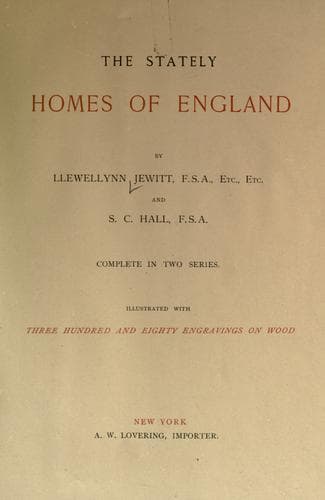
The Stately Homes of EnglandJewitt, Llewellynn Frederick William
History
The Stately Homes of England
Jewitt, Llewellynn Frederick William
Historic buildings -- England
The arms of the duke are—_Sable_, three harts’ heads, caboshed,
_argent_, attired _or_. Crest, a serpent, noued, _proper_. Supporters,
two bucks, _proper_, each wreathed round the neck with a chaplet of
roses, alternately _argent_ and _azure_.
We now, for the present, leave the genealogical part of our story to
turn to the attractions of the interior of the Hall. Of the exterior
and interior of the old hall and their surroundings we shall speak
later on.
[Illustration: _The Grand Staircase._]
Passing through the entrance gateway, shown in one of our
illustrations, the visitor to Hardwick will see before him, across
the quadrangular space laid out in magnificent flower-beds in the
pure Elizabethan style—the most striking feature of which are two
immense beds, one on either side the central pathway, formed in the
shape of the letters E and S, the initials of Elizabeth, Countess of
Shrewsbury—in all its grandeur, the principal front of the Hall, which
bears out to the full the truth of the common saying—
“Hardwick Hall,
More glass than wall.”
The house is in reality “all windows,” and has a peculiarity of
appearance possessed by no other existing mansion. Passing under the
colonnade, seen in the centre of the building in our illustration on
page 122, the visitor arrives at the entrance door, and will, before
entering, do well to glance at an inscription, now nearly defaced, on
one of the pillars:—
“Hic locus est quem si verbis audacia detur
Haud meum magni dixisse palatia coeli,”
which may be thus freely rendered:—
“Could any adventurous muse these portals sing,
No more to Heaven’s gate her flight she’d wing.”
The GREAT HALL, which is first entered, is of considerable magnitude,
and very lofty, taking in the whole height of two stories of the noble
building. Its lower part is wainscoted; its upper, hung with fine
Gobelins tapestry. Along one side stands an enormous and massive oak
table, and carved chairs and seats in abundance are ranged around the
room. Over the entrance end a spacious gallery, supported on pillars,
leads from the dining-room to the drawing-room, on the first floor; and
at the opposite end is a charming piece of sculpture, a full-length
statue of Mary, Queen of Scots, by Westmacott, with the inscription—
“Maria Scotorum Regina
Nata 1542
A suis in exilium acta 1568
Ab hospita neci data 1587.”
Public-domain text, read in full here on John Shaqi.
Reviews
Reviews
No reviews yet
Be the first to share your thoughts on this work.
Elsewhere in the archive
Join the Discussion
Join the discussion
Sign in to leave a comment or review.
Sign InorCreate an account