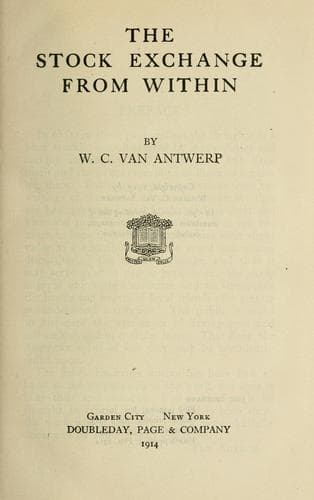
The Stock Exchange from WithinVan Antwerp, William C. (William Clarkson)
History
The Stock Exchange from Within
Van Antwerp, William C. (William Clarkson)
New York Stock Exchange; Stock exchanges
In the Middle Ages the notion prevailed that there was a just and
equitable price for everything, and that any person who tried to obtain
more than this price was a sinner. Trade for gain was anathema; the
man who bought the principal commodities of that time, such as corn
or herrings, with a view to selling them at a profit, was guilty of
“craft and sublety”--as the old English statutes read--that infallibly
cost him his goods and brought him to the pillory. Thus in the year
1311 one Thomas Lespicer of Portsmouth was caught red-handed in London
with six pots of Nantes lampreys stored in a fishmonger’s cellar in
the hope of a rising market. The law required that when he arrived in
London from Portsmouth with his lampreys he should proceed to the open
market under the wall of St. Margaret’s Church in Bridge Street, and
stand there four days selling at current prices to any one who cared to
buy. His failure to do so, and his wickedness in attempting to “bull”
the lamprey market by hiding them in the fishmonger’s cellar, resulted
in the arrest of himself and the fishmonger, and their trial and
punishment at the hands of the Mayor and Alderman.
Professor W. T. Ashley, who cites this incident in his “Introduction to
English Economic History and Theory” (London 1892), also gives another
instance in which our modern theories of natural rights and freedom
of contract seem to be in hopeless conflict. John-at-Wood, a baker,
was arrested in 1364 charged with the profane practice of “bulling”
wheat. “Whereas one Robert de Cawode,” the indictment reads, “had two
quarters of wheat for sale in common market on the pavement within
Newgate; he, the said John, cunningly and by secret words whispering
in his ear, fraudulently withdrew Cawode out of the common market, and
they went together into the Church of the Friars Minor, and there John
bought the two quarters at 15½d per bushel, being 2½d over the common
selling price at that time in the market, to the great loss and deceit
of the common people, and to the increase of the dearness of wheat.”
At-Wood denied this heinous offence and “put himself on the country,”
whereupon a jury was empanelled, which gave a verdict that At-Wood had
not only thus bought the grain, but that he had afterward returned
to the market and boasted of his crime, and “this he said and did to
increase the dearness of wheat.” Accordingly he was sentenced to be put
in the pillory for three hours, and one of the sheriffs was directed
to see the sentence executed and proclamation made of the cause of the
punishment.
Public-domain text, read in full here on John Shaqi.
Reviews
Reviews
No reviews yet
Be the first to share your thoughts on this work.
Elsewhere in the archive
Join the Discussion
Join the discussion
Sign in to leave a comment or review.
Sign InorCreate an account