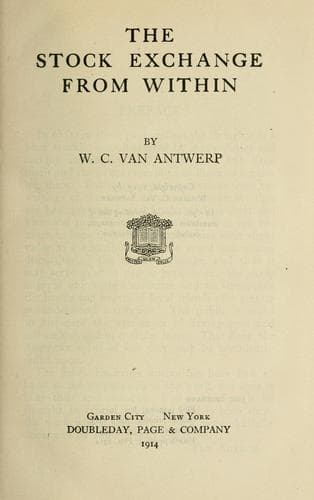
The Stock Exchange from WithinVan Antwerp, William C. (William Clarkson)
History
The Stock Exchange from Within
Van Antwerp, William C. (William Clarkson)
New York Stock Exchange; Stock exchanges
“In fixing my name to this report, I desire to make the
reservations following: 1. With regard to incorporation, I object
to recommend it for the following reasons: Hitherto, the Stock
Exchange has been carried on with great success as a voluntary
association, and has had a vigorous growth. It has not enjoyed a
single legal privilege, yet it has thriven and the public have
neglected more than one effort to establish an open market to
resort to it for business, and to give it exclusive confidence.
This royal commission has been sitting more than twelve months,
yet no important or reliable evidence has been volunteered of a
character adverse to the general practices or conduct of business
on the Stock Exchange. If proof be required that the internal
legislation and administration of the Stock Exchange enforce a
higher standard of morality than the law can reach or enacts for
the regulation of other trades, such proof is to be found in
the fact that recently the committee of the Stock Exchange were
assailed at law by a member whom they expelled on a charge of
dishonorable conduct, the lawsuit being based on the ground that
the action of the committee was not justified in law. The trial
lasted seven days and proved abortive, the distinction between the
standard enforced by the committee and the statutory provisions of
the law not being appreciated by the special jury promiscuously
selected from various trades, although quite intelligible to
the judge. In maintaining this high standard the committee are
compelled to go beyond the common law, binding their members to
the observance of their rules and practices, even though not
enforceable in a court of law. If, however, they should submit to
incorporation, their rules would have to be assimilated to the
law, and their freedom of action would be curtailed--results which
might tend to cripple them in sustaining the standard alluded
to, and operate in many ways as a hindrance to that rapidity of
action which is an absolute necessity in critical times. Further,
incorporation implies, in some sort, monopoly, and it remains to be
proved that the public would gain by any restriction of the freedom
of trade, even in stocks and shares. I adhere to the opinion
expressed in 1875 by the Committee on Foreign Loans, on page 47 of
their report, as follows: ‘That such a body (the Stock Exchange)
can be hardly interfered with by Parliament without losing that
freedom of self-government which is the only life and soul of
business.’”
Public-domain text, read in full here on John Shaqi.
Reviews
Reviews
No reviews yet
Be the first to share your thoughts on this work.
Elsewhere in the archive
Join the Discussion
Join the discussion
Sign in to leave a comment or review.
Sign InorCreate an account