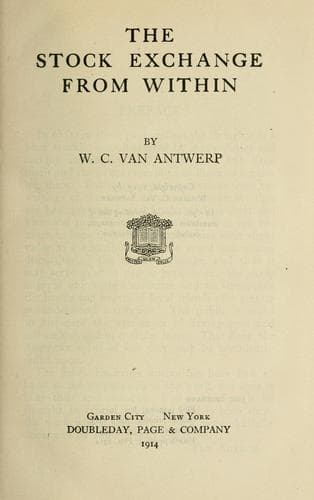
The Stock Exchange from WithinVan Antwerp, William C. (William Clarkson)
History
The Stock Exchange from Within
Van Antwerp, William C. (William Clarkson)
New York Stock Exchange; Stock exchanges
(3) The business of the great banks has been increased at the
expense of their smaller rivals. The prohibition of trading for the
account made it difficult for the latter to carry out customer’s
orders because the new methods required large supplies of both
cash and securities. Furthermore, an increasing share of the
business of the large banks came to be settled by offsets among
their customers, and the actual exchange transactions became a
proportionally small part of the total transfers.
(4) This has a twofold effect. Business within the banks is done on
the basis of exchange prices, but these became more fluctuating and
subject to manipulation as the quantity of exchange dealings were
diminished and were concentrated in a few hands. The advantages of
a broad open market were lost. The object of the act had been to
lessen the speculative influence over industrial undertakings. Its
effect was to increase it.
(5) Finally, the effect of interference, increased cost, and legal
uncertainty was to drive business to foreign exchanges and diminish
the power of the Berlin Exchange in the field of international
finance. The number of agencies of foreign houses increased four
or five fold and much German capital flowed into other centres,
especially London, for investment or speculation. This in turn
weakened the power of the Berlin money market, so that even the
Reichbank has at times felt its serious effects.[84]
Concerning the “Exchange Register” (which the government has now
abolished as a complete failure) and the effort to keep the public out
of the speculative markets, Professor Emery says:
In one sense the fate of the famous exchange register is laughable,
but in a deeper sense it is genuinely sad, for the object was a
worthy one and the new scheme was adopted with high hopes. Its
failure was inevitable, since it did not remove the temptation
to speculate. The men who felt this temptation most, and whose
position least warranted their yielding to it, were of course the
very last men to have themselves registered. In fact the whole
public revolted. The number of registrations never reached four
hundred, which number would not begin to cover the banking and
brokerage concerns. The number of “Outsiders” registered never
reached forty. Even the conservative banks had to choose between
giving up all such business and dealing with non-registered parties.
(1) The uncertainties of the new situation were most likely to
exclude the cautious and well-to-do from participation in the
market. The reckless gambler of small means was less likely to be
disturbed in his practices.
Public-domain text, read in full here on John Shaqi.
Reviews
Reviews
No reviews yet
Be the first to share your thoughts on this work.
Elsewhere in the archive
Join the Discussion
Join the discussion
Sign in to leave a comment or review.
Sign InorCreate an account