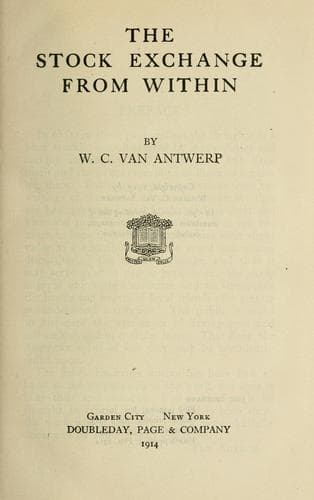
The Stock Exchange from WithinVan Antwerp, William C. (William Clarkson)
History
The Stock Exchange from Within
Van Antwerp, William C. (William Clarkson)
New York Stock Exchange; Stock exchanges
It is probably true that in such event the lessons taught by earlier
legislative experiments, and particularly by the German fiasco, will
have their effect in checking hasty legislation; in any event it would
seem impossible that the teachings of all the economists--scientific
contributions to literature that to-day comprise a large library--can
be ignored in any future discussion of this subject. Meantime,
accepting as our major premise the enduring presence of speculation
as a fixed and immutable characteristic of human nature the world
over--there remains the plain warning to Stock Exchanges and their
governors that fences must be mended as gaps occur, and that the
control of the business in the interest of the public must be the loyal
motive of all these institutions. It will not suffice to whitewash
indefensible conditions, nor to hide from public scrutiny any detail of
a business which that public is asked to support. Conversely, it may
be pertinent to say that in the effort to remedy some of the evils of
speculation the private citizen has his responsibilities as well as the
stockbroker.
Looking forward toward the great questions of the future having to
do with State regulation of industry and commerce of which the Stock
Exchange is a part, the student finds no solution so satisfactory as
the doctrine of _laissez faire_, assuming always that those in control
of the business under scrutiny shall do their full duty. Under the
policy England has risen to unexampled commercial supremacy, while
America, because serious mistakes have been made, finds its advocates
of State regulation growing daily in number, with consequent danger to
all its delicate commercial machinery.
In these circumstances how has the Exchange met its duties and its
responsibilities? The answer is to be found in its records for the year
1913. Prior to that time there was undeniably a careless acceptance of
old standards without inquiring too closely into them; letting things
drift was the rule. But it is never too late to mend, and in 1913 the
Exchange met the issues squarely.
Manipulation was stopped, in so far as it can be stopped, by the famous
resolution of February 5, 1913, reading as follows:
“At a meeting of the Governing Committee held this day, the following
resolution was adopted:
“_Resolved_: That no Stock Exchange member, or member of a Stock
Exchange firm, shall give, or with knowledge execute, orders for
the purchase or sale of securities which would involve no change of
ownership.
“The punishment for this offense shall be as prescribed in Section
8 of Article XXIII of the Constitution regarding fictitious
transactions.”
Trading on insufficient margins was stopped by the resolution of
February 13, 1913, as follows:
“At a meeting of the Governing Committee held this day, the
following resolutions were adopted:
Public-domain text, read in full here on John Shaqi.
Reviews
Reviews
No reviews yet
Be the first to share your thoughts on this work.
Elsewhere in the archive
Join the Discussion
Join the discussion
Sign in to leave a comment or review.
Sign InorCreate an account