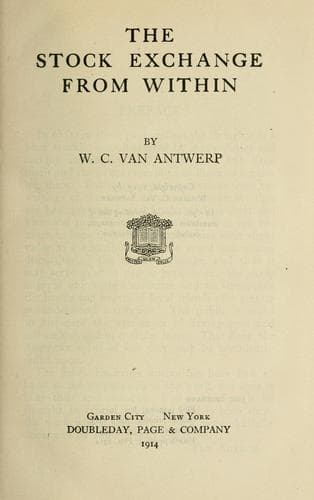
The Stock Exchange from WithinVan Antwerp, William C. (William Clarkson)
History
The Stock Exchange from Within
Van Antwerp, William C. (William Clarkson)
New York Stock Exchange; Stock exchanges
This means that a member must choose his partners carefully, must
familiarize himself with what they are doing, and must know how to
read every entry on the firm’s books. Then, too, it is immensely
satisfactory to one who has been on the floor all day and more or less
out of touch with his office details to learn of his own knowledge each
day, before he goes home, just where the firm stands. He looks over the
customers’ accounts, the loans, and the nature and amount of the firm’s
unemployed resources, including its balances at the banks. Such a man
sleeps well, and reduces to a minimum the anxieties that, at critical
times, make of this a nerve-racking occupation. It is all simple
enough, and in the modern methods of office economy in bookkeeping he
can do it without loss of time. Above all other considerations, such a
man knows his business thoroughly from top to bottom, and he should not
think of investing his capital on any other basis.
Perhaps a word will not be amiss regarding partnership agreements. A
Stock Exchange commission business is one that should be conducted like
any other business--that is to say, reserves should be laid aside and
surplus balances created for the inevitable rainy day. That this is not
done by all brokerage houses in the way it should be done is due to
the curious habit that has grown with the years, whereby stockbrokers
spend their money, uptown and down, with a lavish hand. Too many men of
the younger generation thus give hostages to fortune in their private
extravagances by “drawing down” their credit balances as fast as they
accrue. “Easy come, easy go,” seems to be the guiding principle, and
when hard times come, as come they must, debit balances are created
that soon eat into capital account.
No hard and fast rule can be laid down to meet conditions like these,
but the best method I have seen, and the one most wisely designed
to avoid mishaps for beginners, consists in a partnership agreement
by which each member of the firm may draw a monthly sum, worked out
to meet his normal requirements, _and no more_. All that remains is
then turned into capital account, where it draws interest, becomes a
producer, and grows by what it feeds on. I have in mind a firm of young
men who some years ago resorted to this method of compulsory saving,
with such success that, despite the vicissitudes of the passing years,
the members comprising it are now all wealthy, attributing their good
fortune wholly to this wise and provident copartnership agreement.
Public-domain text, read in full here on John Shaqi.
Reviews
Reviews
No reviews yet
Be the first to share your thoughts on this work.
Elsewhere in the archive
Join the Discussion
Join the discussion
Sign in to leave a comment or review.
Sign InorCreate an account