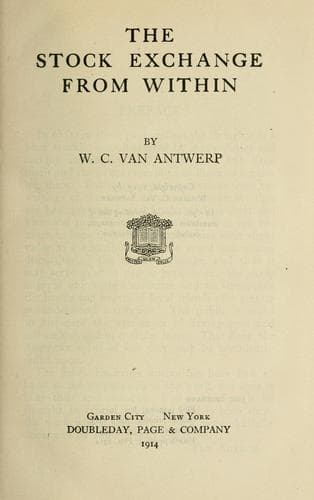
The Stock Exchange from WithinVan Antwerp, William C. (William Clarkson)
History
The Stock Exchange from Within
Van Antwerp, William C. (William Clarkson)
New York Stock Exchange; Stock exchanges
The vocation of the specialist is one that causes frequent comment and
ill-merited abuse. It has been charged that he sometimes exercises
arbitrary power in executing his orders, and complaint is heard that
the price at which he deals is not always a fair price. My observation
is that four times out of five the fault lies, not with the specialist,
but with the broker who gives him the order. The latter has been trying
to do too much, he has held the order in his hand whilst engaged
elsewhere in the hope of saving the commission for himself, and then,
when he has “missed his market,” turns the order over to the specialist
and shifts the responsibility to his shoulders. This is scarcely fair,
and it simply should not happen. The customer protests at the delay and
at the price; he is told the specialist is responsible, and straightway
another voice joins the chorus that holds the specialist in abhorrence.
Like the chairman of the House Committee of a club, the specialist
is made to bear everybody’s burdens; he is the target for all the
criticism that any one chooses to hurl at him. And yet he is one of
the most useful and indispensable features of the Exchange machinery.
Without him there would be no market whatever in very many securities;
like the London jobber, he is constantly on the spot, ready to take
chances by creating at his personal risk a market where none may have
existed. If it be urged that the specialist should not speculate, but
should confine himself solely to executing the orders on his books, it
may be answered that in such a case he would often be useless, for in
many instances the orders on his books are insufficient in volume to
establish a close market or anything approaching it. By reason of his
speculations a market is created; without them it may not exist. He
speculates, therefore, for the same reason that jobbers in the London
market speculate, and dealers in wheat, cotton, and wool. Like them, he
must have goods on hand to supply the demand, and in the purchase of
these goods (securities) he speculates, legitimately, on the hope or
belief that buyers will appear.
Public-domain text, read in full here on John Shaqi.
Reviews
Reviews
No reviews yet
Be the first to share your thoughts on this work.
Elsewhere in the archive
Join the Discussion
Join the discussion
Sign in to leave a comment or review.
Sign InorCreate an account