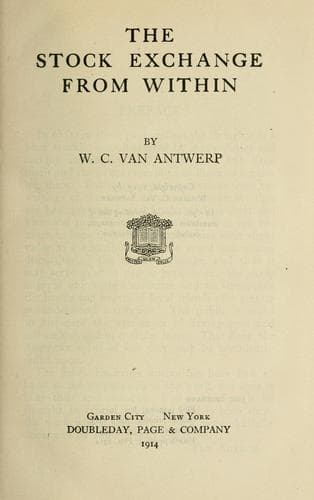
The Stock Exchange from WithinVan Antwerp, William C. (William Clarkson)
History
The Stock Exchange from Within
Van Antwerp, William C. (William Clarkson)
New York Stock Exchange; Stock exchanges
There were Exchanges in London in the sixteenth century. Merchants from
Lombardy had given their name to a street, and had flourished so well
that they had branched out in the business of money-changing--that is,
of exchanging worn, abrased and clipped coins, foreign and domestic,
for those of standard weight and fineness. As trade increased and the
first faint signs of progress in the matter of wealth began to develop,
it was seen that this business of exchanging money was sufficiently
important to warrant royal recognition; accordingly there was created
the office of Royal Exchanger, and the person entrusted with this
office was given the privilege of exchanging coins in the manner
described. Smaller offices for the purpose were farmed out in other
English towns, and each place where the business was carried on thus
came to be known as “The Exchange,” a name that was ultimately applied
to any covered place where merchants met to buy and sell commodities.
After the money-changers came the money-lenders--Jews, more
Lombards, and finally the Guild of Goldsmiths. The last named,
having long practised the business of money-lending, finally became
money-borrowers, issuing receipts for these borrowings known as
Goldsmiths’ Notes--the earliest form of English bank-notes--and the
first step in the convenient process of translating capital, and debt,
and credit, into bits of interest-bearing paper.[102] This was the
state of English finance until 1694, when the Bank of England was
founded, and stocks and shares came into being since the bank was
a joint-stock affair. That the invention of stock certificates was
a popular one, and that the authorities and the public seized upon
it as a convenient means of directing capital into new and hitherto
untried forms of enterprise is seen by the rapidity with which fresh
undertakings were put forth. In 1698 the New East India Company
loaned its capital to the government; by 1711 there was a funded
debt of £11,750,000 in the shape of bank stock, East India stock, and
annuities. There was also the famous South Sea Company, to be followed
ten years later by a reorganization of the company with its first
subscription of a million in £100 stock at £300, and a second and
third subscription of larger magnitude, each accompanied by prodigious
promises, and each snapped up with avidity by a public saturated with
the new and hazardous pastime of speculation.
Public-domain text, read in full here on John Shaqi.
Reviews
Reviews
No reviews yet
Be the first to share your thoughts on this work.
Elsewhere in the archive
Join the Discussion
Join the discussion
Sign in to leave a comment or review.
Sign InorCreate an account