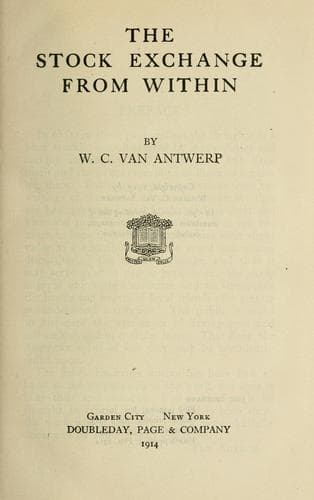
The Stock Exchange from WithinVan Antwerp, William C. (William Clarkson)
History
The Stock Exchange from Within
Van Antwerp, William C. (William Clarkson)
New York Stock Exchange; Stock exchanges
We have authority for the early history of the London Stock Exchange in
a report made in 1877 by the officials of the institution to the Royal
Commission. From this report it appears that the Stock Exchange at New
Jonathan’s in 1773 “afforded a ready market for the operations of the
bankers, merchants, and capitalists connected with the floating of the
numerous loans raised at that period for the service of the State.”
The members or frequenters paid a subscription of sixpence to defray
expenses, drew up rules, and placed its control in the hands of a
“Committee for General Purposes.” The functions of this committee were
then, as now, “judicial as regards the settlement of disputed bargains,
and administrative as regards rules for the general conduct of business
and for the liquidation of defaulter’s accounts.” The earliest minutes
on record are dated December, 1798.
War loans and a national debt increasing by leaps and bounds, with
consequent activity in consols, was the principal source of business in
those early days, and as these increased, so also the savings of the
public and a new national spirit led to a steady growth in the business
of dealing in securities. The dim receding voice of those early days
still echoes in Capel Court through the medium of two holidays--May
1st and November 1st. More than a century ago these days marked the
closing of the Bank of England’s books for the transfer of consols, and
as consols were the only things then traded in, there was nothing for
stockbrokers to do on those occasions; hence they took a holiday. And
they still close the Exchange on these days--an eloquent instance of
the Englishman’s adherence to tradition.
By 1801 there was not room enough in the old building, and, moreover,
the report says: “It became apparent that the indiscriminate admission
of the public was calculated to expose the dealers to the loss of
valuable property.” Accordingly a group of Stock Exchange men acquired
a site in Capel Court, close to the bank, raised a capital of £20,000
in four hundred shares of £50 each, and in May, 1801, laid the
foundation of what has become through numerous additions the London
Stock Exchange of to-day. The building was opened in March, 1802, with
a list of five hundred subscribers, and the deed of settlement (March
27, 1802), vested the management in a committee of thirty members,
chosen annually by ballot, with nine trustees and managers, separate
from the committee, to have charge of the treasury and represent the
proprietors. Although the rules and regulations have been amended and
enlarged from time to time to meet new conditions, the constitution of
the London Stock Exchange remains substantially unaltered.
Public-domain text, read in full here on John Shaqi.
Reviews
Reviews
No reviews yet
Be the first to share your thoughts on this work.
Elsewhere in the archive
Join the Discussion
Join the discussion
Sign in to leave a comment or review.
Sign InorCreate an account