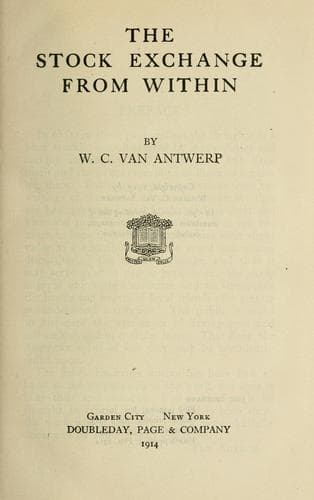
The Stock Exchange from WithinVan Antwerp, William C. (William Clarkson)
History
The Stock Exchange from Within
Van Antwerp, William C. (William Clarkson)
New York Stock Exchange; Stock exchanges
And yet, ere we go too far afield in search of the shivers, the
observer must bear in mind that this great credit system of which
London is the banker and clearing house, in reality knits together
in its international web all the great powers, and binds them so
closely together as to guarantee, in some measure, the preservation of
peace. That peace hath her victories, and that the creation of wealth
through industrial pursuits may serve in this way to prevent armed
strife--these are, after all, encouraging indications quite as strong
as treaties. To-day the bankers of London and Paris are the war lords
of creation. Both these centres loan money, on early maturing bills,
to all the world. Stop London’s discounts through an outbreak of war,
and gold would pour into that centre at the rate of $200,000,000 a
month. “It might be possible to starve her population,” says a recent
writer, “but no combination of the Powers could bankrupt London. In
the event of war Paris could bankrupt Germany in a week. No war could
disturb the credit of the Bank of France; but the German Reichsbank
would inevitably go down in the smash. All Germany’s capital is in her
own shop. She is doing a great business, and, quite properly, a great
part of it on borrowed money. But if her loans were called, she must
put up the shutters.”[113]
Let us now observe the London broker at his work. The Stock Exchange,
as has been described, settles nearly all of its transactions twice
a month, upon officially appointed “account days,” which fall about
the middle and the end of every month. Smith, a broker, receives an
order to buy, let us say, 500 East Rands, and goes to a jobber who
makes a specialty of that department. The jobber, Jones, is a wise
man and a clever trader, who knows all there is to know about supply
and demand and regulation of prices to meet them, otherwise he would
soon be out of business. Smith does not tell him what he proposes
to do, but asks for a price, which in normal markets Jones quotes at
3½ to 3-9/16, this being the method of implying, in pounds sterling,
that he is prepared to buy at 70s., or to sell at 71s. 3d. The broker
will probably say that the price is too wide, whereupon Jones quotes a
figure “close to close,” reducing the quotation 1/64 each way, at which
figure the transaction is closed.[114] Smith enters in his book that
he has bought of Jones 500 East Rands at the price stated, and Jones,
that he has sold at this price to Smith. The customer is then advised
of the transaction, and next day he receives his stamped contract,
with details covering the cost of the shares together with brokerage
and other expenses, if any, and informing him of the date of the next
account day, when payment will fall due.
Public-domain text, read in full here on John Shaqi.
Reviews
Reviews
No reviews yet
Be the first to share your thoughts on this work.
Elsewhere in the archive
Join the Discussion
Join the discussion
Sign in to leave a comment or review.
Sign InorCreate an account