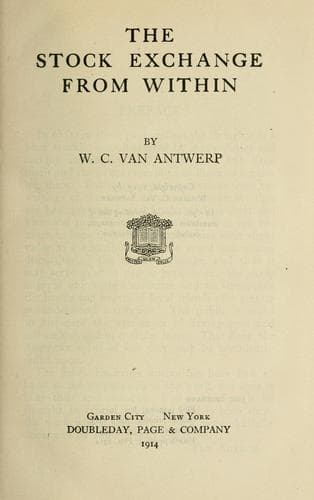
The Stock Exchange from WithinVan Antwerp, William C. (William Clarkson)
History
The Stock Exchange from Within
Van Antwerp, William C. (William Clarkson)
New York Stock Exchange; Stock exchanges
While the government took no hand in the matter, it was recognized
that the coulisse gave to the public market a breadth and activity
that did great good; as a matter of fact it benefited the stockbrokers
themselves in a large way, for it enabled them to obtain from the
government liberties not formerly enjoyed, but practised freely by the
coulissiers, such as transactions in time bargains, dealings in foreign
securities, and similar concessions. This grant of a right to do
business on time, or as we term it “future delivery,” was a tremendous
step forward, since it removed an obstacle in the way of large
speculative markets that had long been abolished in other financial
centres. It put a stop to the “welching” of speculators on the plea
of the gambling act, it legalized short sales, and it established a
distinct advance in economic progress. To that extent the stockbrokers
are indebted to their neighbors on the curb.[125]
Meanwhile, the opposition to the monopoly of the stockbrokers
continues. “At all times,” says M. Vidal, “whenever there have been
privileges, some men have been found to oppose them. Of course, these
men are not theorists or pedants; they are simply men whom this
or that privilege prevents from working freely, and who represent
the manifestation of that mysterious force of things which tends
toward freedom of trade. Commercial law owes its birth only to these
protestations of practical men in apparent revolt against the laws,
which become the unconscious shapers of future legislation. From the
day when there was an _Agent de Change_ there was a “coulissier.”
The first called the second a thief, because he encroached upon his
privilege. The second hurled back the compliment, because the privilege
robbed him of his natural right.”[126]
This has a familiar American ring. In 1843 a voluminous report to the
Minister of Justice by the stockbrokers asked that the coulisse be
destroyed. Nothing came of it, but in 1859 another attempt succeeded;
the coulisse was suppressed. But the level of public credit which,
it was hoped, would be raised by the suppression, actually sank. The
business of the coulisse, and the market it created, disappeared with
the coulisse itself. The government was very sensitive then as now in
the matter of market prices for its rentes, and after the laborious
process of hoisting them to 71, it was distressing to find that,
coincident with the abolition of the curb market, they had fallen to
69. So, in 1861, the coulisse was permitted to reappear, and I fancy
the days of its suppression are now at an end.
Public-domain text, read in full here on John Shaqi.
Reviews
Reviews
No reviews yet
Be the first to share your thoughts on this work.
Elsewhere in the archive
Join the Discussion
Join the discussion
Sign in to leave a comment or review.
Sign InorCreate an account