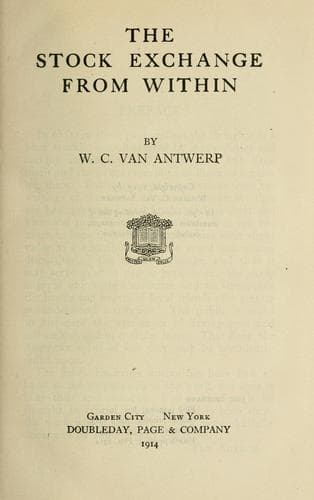
The Stock Exchange from WithinVan Antwerp, William C. (William Clarkson)
History
The Stock Exchange from Within
Van Antwerp, William C. (William Clarkson)
New York Stock Exchange; Stock exchanges
The mechanism of the Exchange provided by its constitution and
rules, is the evolution of more than a century. An organization of
stockbrokers existed here in 1792, acquiring more definite form in
1817. It seems certain that for a long period the members were brokers
or agents only; at the present time many are principles as well as
agents, trading for themselves as well as for their customers. A number
of prominent capitalists hold memberships merely for the purpose of
availing themselves of the reduced commission charge which the rules
authorize between members.
The volume of transactions indicates that the Exchange is to-day
probably the most important financial institution in the world. In the
past decade the average annual sales of shares have been 196,500,000 at
prices involving an annual average turnover of nearly $15,500,000,000;
bond transactions averaged about $800,000,000. This enormous business
affects the financial and credit interests of the country in so large
a measure that its proper regulation is a matter of transcendent
importance. While radical changes in the mechanism, which is now so
nicely adjusted that the transactions are carried on with the minimum
of friction, might prove disastrous to the whole country, nevertheless
measures should be adopted to correct existing abuses.
PATRONS OF THE EXCHANGE
The patrons of the Exchange may be divided into the following groups:
(1.) Investors, who personally examine the facts relating to the
value of securities or act on the advice of reputable and experienced
financiers, and pay in full for what they buy.
(2.) Manipulators, whose connection with corporations issuing
or controlling particular securities enables them under certain
circumstances to move the prices up or down, and who are thus in some
degree protected from dangers encountered by other speculators.
(3.) Floor traders, who keenly study the markets and the general
conditions of business, and acquire early information concerning the
changes which affect the values of securities. From their familiarity
with the technique of dealings on the Exchange, and ability to act in
concert with others, and thus manipulate values, they are supposed to
have special advantages over other traders.
(4.) Outside operators having capital, experience, and knowledge of the
general conditions of business. Testimony is clear as to the result
which, in the long run, attends their operations; commissions and
interest charges constitute a factor always working against them. Since
good luck and bad luck alternate in time, the gains only stimulate
these men to larger ventures, and they persist in them till a serious
or ruinous loss forces them out of the “Street.”
(5.) Inexperienced persons, who act on interested advice, “tips,”
advertisements in newspapers, or circulars sent by mail, or “take
flyers” in absolute ignorance, and with blind confidence in their luck.
Almost without exception they eventually lose.
CHARACTER OF TRANSACTIONS
Public-domain text, read in full here on John Shaqi.
Reviews
Reviews
No reviews yet
Be the first to share your thoughts on this work.
Elsewhere in the archive
Join the Discussion
Join the discussion
Sign in to leave a comment or review.
Sign InorCreate an account