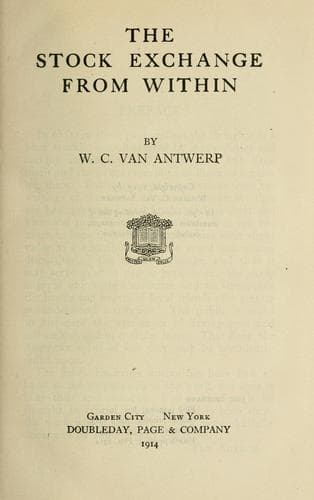
The Stock Exchange from WithinVan Antwerp, William C. (William Clarkson)
History
The Stock Exchange from Within
Van Antwerp, William C. (William Clarkson)
New York Stock Exchange; Stock exchanges
It also permits dealing in shares not listed in the main exchange, and
in certain mining shares, generally excluded from the other. In these
cases it prescribed a form of listing requirements, but the original
listing of securities is very rarely availed of. The rules also provide
for dealing in grain, petroleum, and other products. Wheat is, however,
at present the only commodity actively dealt in, and this is due solely
to the permission to trade in smaller lots than the Produce Exchange
unit of 5000 bushels.
There are 1225 members, about 450 active, and memberships have sold
in recent years at from $650 to $2000. In general the methods of
conducting business are similar to those of the larger exchange, and
subject to the same abuses.
Very strained relations have existed between the two security exchanges
since the lesser one undertook in 1886 to deal in stocks. The tension
has been increased by the methods by which the Consolidated obtains the
quotations of the other, through the use of the “tickers” conveying
them. It is probable that without the use of these instruments the
business of the Consolidated Exchange would be paralyzed; yet the right
to use them rests solely upon a technical point in a judicial decision
which enjoins their removal.
COGNATE SUBJECTS
HOLDING COMPANIES
Connected with operations on the Stock Exchange are a class of
manipulations originating elsewhere. The values of railway securities,
for example, depend upon the management of the companies issuing them,
the directors of which may use their power to increase, diminish,
or even extinguish them, while they make gains for themselves by
operations on the Exchange. They may advance the price of a stock by
an unexpected dividend, or depress it by passing an expected one. They
may water a stock by issuing new shares, with no proportionate addition
to the productive assets of the company, or load it with indebtedness,
putting an unexpected lien on the shareholders’ property. Such
transactions affect not only the fortunes of the shareholders, who are
designedly kept in ignorance of what is transpiring, but also the value
of investments in other similar companies the securities of which are
affected sympathetically. Railroad wrecking was more common in the last
half-century than it is now, but we have some glaring examples of it in
the débris of our street railways to-day.
The existence and misuse of such powers on the part of directors are
a menace to corporate property and a temptation to officials who are
inclined to speculate, leading them to manage the property so as to
fill their own pockets by indirect and secret methods.
Public-domain text, read in full here on John Shaqi.
Reviews
Reviews
No reviews yet
Be the first to share your thoughts on this work.
Elsewhere in the archive
Join the Discussion
Join the discussion
Sign in to leave a comment or review.
Sign InorCreate an account