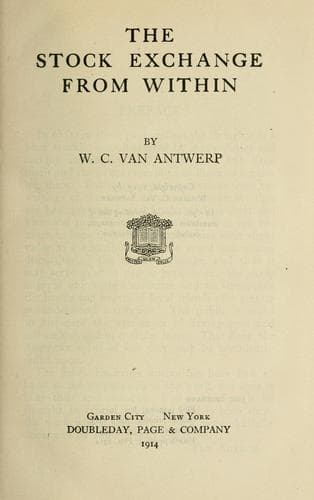
The Stock Exchange from WithinVan Antwerp, William C. (William Clarkson)
History
The Stock Exchange from Within
Van Antwerp, William C. (William Clarkson)
New York Stock Exchange; Stock exchanges
[34] “The borrower is also bound to pay the lender whatever interest by
way of coupons or dividends or otherwise and all bonuses and accretions
that would have been paid to the lender on the securities he has lent
had he kept them. These are in practice treated as increases to the
market price of the borrowed securities. The reason for this provision
is that the lender is the actual owner of the securities and as such
owner he is entitled to whatever they may earn by way of interest or
in any other way. He has simply temporarily let another have the use
of them, and, since the securities can be and are disposed of by the
borrower, the lender would lose the interest, etc., which is paid on
the borrowed securities between the date that they are borrowed and
the date when they are returned and the loan cancelled, unless the
borrower paid an equivalent amount to him. On the other hand, any
assessment the lender would have had to pay on the borrowed securities
during the continuance of the loan is a charge against him; for such an
assessment is a burden adherent to ownership. In practice it is treated
as a reduction of the market price.”--Eliot Norton “On Short Sales of
Securities through a Stockbroker.” The John McBride Co., New York, 1907.
[35] (Memorial of the stockbrokers addressed to the Minister of
Finance, 1843, p. 44, footnote. Quoted by Vidal, _q. v._, p. 46.)
[36] Some of those who admit the value of the stock market have
subjected to severe criticism those who speculate for the fall of
stocks. One reads constantly of the “bears” trying to accomplish such
and such results by depressing securities. Napoleon had a long talk
with Mollien, his Minister of Finance, in seeking to demonstrate that
those who sold “short,” in the belief that national securities would
fall, were traitors to their country. He argued that if these men were
selling national securities for future delivery at less than their
present value they were guilty of treason to the State. But Mollien
replied in substance: “These men are not the ones who determine the
price; they are only expressing their judgment upon what it will be.
If they are wrong, if the credit of our State is to be maintained in
the future at its former high standard, in spite of your military
preparations, these men will suffer the penalty by having to make
delivery at the price for which they sold, for they must go into the
market and buy at the price then prevailing. It is their judgment, not
their wish, that they express.”--“Wall Street and the Country,” by
Charles A. Conant, pp. 111–112, G. P. Putnam’s Sons, New York, 1904.
[37] “Lombard Street,” p. 158.
[38] Charles A. Conant, “Principles of Money and Banking” (New York,
1905). The reader is invited to consult, in this connection, that
portion of the Report of the Hughes Commission, (see Appendix) having
to do with short selling.
[39] Report of the Commissioner, Washington, 1908.
Public-domain text, read in full here on John Shaqi.
Reviews
Reviews
No reviews yet
Be the first to share your thoughts on this work.
Elsewhere in the archive
Join the Discussion
Join the discussion
Sign in to leave a comment or review.
Sign InorCreate an account