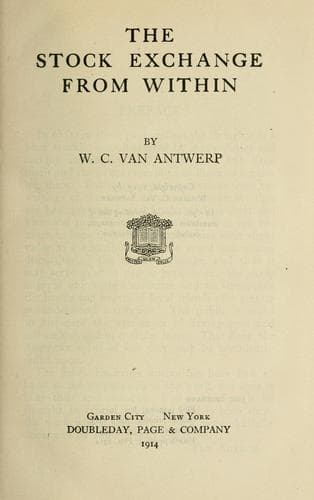
The Stock Exchange from WithinVan Antwerp, William C. (William Clarkson)
History
The Stock Exchange from Within
Van Antwerp, William C. (William Clarkson)
New York Stock Exchange; Stock exchanges
[54] When the first issue of Union Pacific convertible bonds matured,
so many people had failed to notice that their bonds could be exchanged
dollar for dollar against the stock, selling at much higher price with
greater yield, that the company extended the time for conversion. It
would have been entirely warranted in paying off such bondholders at
par, but it spent considerable sums in advertising them of a privilege
they should have known all about. In the face of all this, bonds
came in for conversion many months after the extended time, and the
bondholder sincerely believed that he had a grievance because his bond
was redeemed at par.
The same thing happened in the case of the old St. Paul 7’s, which
were convertible into preferred stock. Bondholders allowed themselves
to be paid off at par for a bond which had been standing at 170 and
apparently had never read the terms of their own mortgage. What can the
law, the press, or the banker do against such criminal negligence as
this? And if bondholders are remiss, what shall be said of the average
stockholder? He is improving undoubtedly, but he has still a great deal
to learn. His right to information is unquestionable, but he fails to
exercise it in anything like the degree he should. It is to be feared
also that he does not take a great deal of trouble in learning to
analyze such reports and balance sheets as may be submitted to him.
A stockholder should never hesitate to write to the officers of his
company for information. He should do it often, and he should get other
stockholders to do the same thing. One stockholder writing frequently
may be regarded as a nuisance. Ten will be treated with respect,
and it will be a very autocratic control which will venture to deny
information to a hundred stockholders, taking a legitimate step to
protect their own proper interests. The newspapers are glad to furnish
any information in their power, but if the stockholder would write to
the company first and the newspaper afterward, he would probably derive
more ultimate advantage.--_Wall Street Journal_, September 22, 1909.
[55] Address by President Finlay of the Southern Railway, before the
Transportation Club of Indianapolis, October, 1912.
[56] “If there is one man who really understands the nature of the
transactions in the New York Stock Exchange from day to day, it
is Robert L. Doremus, the chairman of the Stock Exchange Clearing
House Committee, which has the power to lay bare the character of
any broker’s business. His reputation for veracity is of that high
character which Wall Street demands from the men in its responsible
positions. When he says that the main influence in any day’s trading is
a legitimate and widespread demand for sound securities, in lots small
enough to be within reach of the investor of moderate means, he is
talking facts and not theories.
Public-domain text, read in full here on John Shaqi.
Reviews
Reviews
No reviews yet
Be the first to share your thoughts on this work.
Elsewhere in the archive
Join the Discussion
Join the discussion
Sign in to leave a comment or review.
Sign InorCreate an account