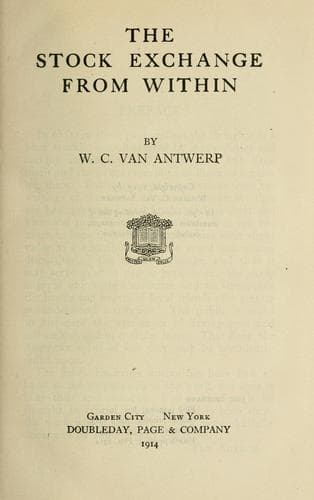
The Stock Exchange from WithinVan Antwerp, William C. (William Clarkson)
History
The Stock Exchange from Within
Van Antwerp, William C. (William Clarkson)
New York Stock Exchange; Stock exchanges
[109] Rule 150 reads as follows: “The committee will not fix a
special settling day for bargains in shares or securities issued
to the vendors, credited as full or partly paid, until six months
after the date fixed for the special settlement in the shares or
securities of the same class subscribed for by the public, but this
does not necessarily apply to reorganizations or amalgamations of
existing companies, or to cases where no public shares are issued for
cash.”--Rules and Regulations of the Stock Exchange. London, June 3,
1911, pp. 64–5.
[110] These figures are taken from Mr. Hirst’s Chapter VIII on “The
Creation of New Debt and Capital,” pp. 212–241.
[111] It should be said that at least a part of the decline in these
securities had taken place before the Balkan scare became a reality.
A foreknowledge of what was impending may have influenced the earlier
decline; certainly the event itself accentuated and hastened it.
[112] London jobbers were, in a way, instrumental in checking the
furious speculation in “rubbers” toward the culmination of the boom of
1909–10. Their absolute refusal to carry rubber shares for brokers, and
their concerted insistence that such shares should be paid for in full
on the ensuing account day, undoubtedly put the brakes on a furious
speculation, and prevented many failures.
[113] The _Wall Street Journal_, November 13, 1912.
[114] On the New York Stock Exchange the minimum difference between
prices is one eighth and splitting of this fraction is prohibited save
in the case of “rights” to subscribe or similar instances.
[115] In the settling room on ticket day stocks that are not cleared
pass by ticket from broker to broker in much the same way as that
provided by the Clearing House.
[116] Although an effort has been made in these pages to avoid
complicated Stock Exchange technique, the contango, which is not fully
understood in America, requires technical explanation. It may be
defined as a double-bargain, in that it consists of a sale for cash of
the stock previously bought which the broker does not wish to carry,
and a repurchase for the new settlement two weeks ahead, of the same
stock at the same price as the sale, plus interest agreed upon up to
the date of that settlement.
[117] The methods of transacting business on the London Stock Exchange
are admirably stated in condensed form in an article by Walter Landells
in the _Quarterly Review_, July, 1912, pp. 88–109, and I am indebted to
his article for many of the foregoing facts, and for this brief summary
of London’s booms and crises.
[118] In addition to the authorities quoted in the foregoing chapter,
the attention of the reader is directed to the following works having
to do with the London Stock Exchange:
Lombard Street, by Walter Bagehot, New York, Chas. Scribner’s, and Sons.
Stocks and Shares, by Hartley Withers, London, Smith Elder, 1910.
Stock Exchange Law and Practice, by W. A. Bewes, London, Sweet &
Maxwell, 1910.
Public-domain text, read in full here on John Shaqi.
Reviews
Reviews
No reviews yet
Be the first to share your thoughts on this work.
Elsewhere in the archive
Join the Discussion
Join the discussion
Sign in to leave a comment or review.
Sign InorCreate an account