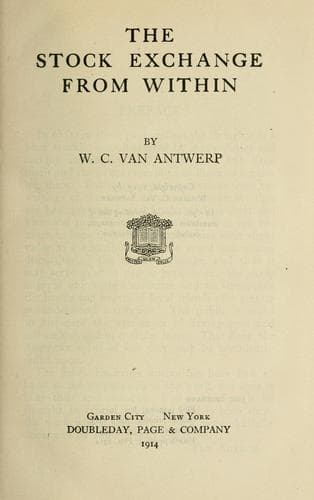
The Stock Exchange from WithinVan Antwerp, William C. (William Clarkson)
History
The Stock Exchange from Within
Van Antwerp, William C. (William Clarkson)
New York Stock Exchange; Stock exchanges
full information and that many avenues by which it may safeguard its
interests are always open.[52]
It has long been known that investors and speculators in America enjoy
vastly more safety in their market operations through these various
avenues of publicity than do investors and speculators abroad. There
are no tickers worthy of the name across the water, and the daily list
of business done, as published in our newspapers, with bid and asked
prices and total transactions in detail, is unheard of among all the
Bourses of Europe. The eminent French economist, Paul Leroy-Beaulieu,
speaks very earnestly of the superiority of our New York Stock Exchange
system in this matter; he says the need for a similar method in France
is “very urgent,” that the information thus spread broadcast is “very
instructive,” that the pledge of publicity “is better assured in the
United States than in any other country of the world,” and that an
immediate reform along these lines is “absolutely necessary” in Paris
in the interest of the public.[53]
This leads to another word of caution suggested by the fact that the
public, despite what is done for it, does not always avail itself of
these safeguards. Men buy worthless mining stocks without bothering
to inquire into their bona fides. They put their savings into new
and untried enterprises and they neither read the balance sheets nor
attend the meetings. A thousand stockholders will attend a meeting in
London and they will have their questions answered whether the majority
in control likes it or not. In New York almost nobody attends these
meetings. The stockholder’s right to information is absolute, but he
does not go and get it, and so finally when something goes wrong he
writes angry letters to the newspapers and damns both Wall Street
and the Stock Exchange because he has been burned, although the fire
escape and the extinguisher were always at his hand. “It is all very
well” says the _Wall Street Journal_, “to talk about what the law,
the newspaper press, and the Stock Exchange can do to protect the
investor, but the investor himself can do more than all his protectors
put together. His investment, however conservative and secure, carries
responsibilities as well as privileges, and it is his duty to discharge
the one in order to safeguard the other.”[54]
He must learn to make inquiries, to discriminate, to use his wits, to
read mortgages, to study sinking funds and operating ratios. He must
eschew the financial columns of questionable newspapers and confine
his attention to those of established probity. He must not put all his
investment eggs into one basket. The Stock Exchange cannot do all this
for him, but it is always ready to help him, and the information he
requires may be had for the asking.
Public-domain text, read in full here on John Shaqi.
Reviews
Reviews
No reviews yet
Be the first to share your thoughts on this work.
Elsewhere in the archive
Join the Discussion
Join the discussion
Sign in to leave a comment or review.
Sign InorCreate an account