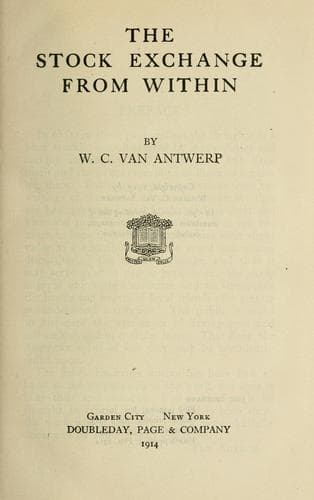
The Stock Exchange from WithinVan Antwerp, William C. (William Clarkson)
History
The Stock Exchange from Within
Van Antwerp, William C. (William Clarkson)
New York Stock Exchange; Stock exchanges
In a recent public address the president of a great American railway
sounded an encouraging note. “We railway men,” he said, “have been in a
practical school, having taken a thorough course in working economics.
We have learned that a railway can thrive only as a result of the
prosperity of the community it serves, and that the best policy, from
the viewpoint of permanent railway interests, is one of co-operative
helpfulness.”[55] The New York Stock Exchange has learned the same
lesson, in a similar school. As an institution it realizes that if it
is to grow in prosperity the public must grow, and that as the public
is attracted to investment and speculation by the soundness of the
institution through which it deals so it requires and must receive full
information and an assurance of fair play. “Co-operative helpfulness”
is the only way. Members of the Exchange who become discouraged now and
then must bear this in mind. In the face of every harassing annoyance
they must never cease their work of keeping their house in order, and
of inviting that portion of the public that is open-minded to lend
a hand. Their labors resemble the task of Sisyphus; like him they
must cultivate the spirit of “everlasting hope,” and when unworthy
assailants seek to prejudice the popular mind, they must stand forth,
give blow for blow, and never say die.
Pessimists may blind their eyes to the manifold evidences of material
progress on every hand, but just as the workshop, the farm, the
school, the hospital, and the bank, each supplies proof of continuing
improvement, so also in its sphere of usefulness does the Stock
Exchange. Within a few years, for example, it has rid itself of the
unlisted department, and this may very properly be mentioned as
a distinct progression. Under the old system a limited number of
industrial corporations were permitted to obtain a market on the
Exchange for their securities, although they furnished but few figures
to the Listing Committee in return. This was a practice wholly at
variance with the duty of the Exchange to protect the investor, since
it practically assures him that corporations admitted to the Exchange
have demonstrated their worth to the authorities. That character and
countenance should be given to the so-called “unlisted department” was
a mistake, and it has been abolished.
Public-domain text, read in full here on John Shaqi.
Reviews
Reviews
No reviews yet
Be the first to share your thoughts on this work.
Elsewhere in the archive
Join the Discussion
Join the discussion
Sign in to leave a comment or review.
Sign InorCreate an account