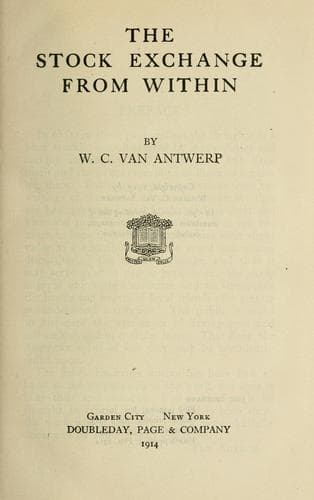
The Stock Exchange from WithinVan Antwerp, William C. (William Clarkson)
History
The Stock Exchange from Within
Van Antwerp, William C. (William Clarkson)
New York Stock Exchange; Stock exchanges
This leads to the subject of “manipulation,” as it is termed, or the
uses to which the facilities of the Exchange are sometimes put to give
certain stocks an appearance of activity out of proportion to their
normal movement. Now we must assume as our major premise in discussing
this matter that any artificial interference with the natural operation
of supply and demand is pernicious; from the standpoint of economics
it is harmful. The Stock Exchange has nothing to conceal, and it
recognizes not only that manipulation exists, but that at times it
assumes the proportions of a real evil. Therefore it is doing what
it can to stop it, and it will continue to do so. Whenever unwonted
activity arises nowadays in a security long dormant, as happened very
recently in the stock of a certain gas company, the governors of the
Exchange entrusted with such things take the matter in hand and put a
stop to it if obvious manipulation can be shown after investigation.
The public and the newspapers know nothing about it; the vial of their
criticism is poured forth only when something escapes the watchful
eye of the Exchange authorities, as must inevitably happen now and
then. But if these critics could know how indignant the members of the
Exchange became when the Hocking Coal episode occurred, and if they
could see the resolute determination of all hands to prevent another
such occurrence, they would at least give the Exchange credit for
faithfully attempting to suppress manipulation of the flagrant sort.
The fact is that all forms of manipulation are by no means improper;
some of it performs a useful service and is a necessary and legitimate
part of the functions of the Exchange. To understand how true this is
let us consider, for example, the case of a corporation that has been
organized, let us say, to develop a group of recently discovered coal
properties in new territory. This is legitimate endeavor as applied to
American enterprise; in a broad sense it is the spirit of adventure and
speculation that has made our country commercially rich and powerful.
Now, in order to develop this enterprise, it is necessary to ask the
public to buy its shares or its certificates of debt and thus become
partners in the undertaking. In that way our great railways were built
and our Western country opened to progress. But the public will not
support the new enterprise until it knows something of its merits, and
accordingly the company introduces its property through the medium of
that great central market-place--the Stock Exchange--furnishing the
Exchange authorities with its credentials in minute detail.
Public-domain text, read in full here on John Shaqi.
Reviews
Reviews
No reviews yet
Be the first to share your thoughts on this work.
Elsewhere in the archive
Join the Discussion
Join the discussion
Sign in to leave a comment or review.
Sign InorCreate an account