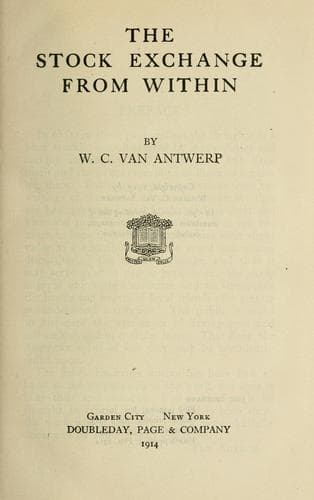
The Stock Exchange from WithinVan Antwerp, William C. (William Clarkson)
History
The Stock Exchange from Within
Van Antwerp, William C. (William Clarkson)
New York Stock Exchange; Stock exchanges
Counsel for the Congressional Committee that is in session as these
lines are written seeks to raise another dreadful ghost with which to
frighten ignorant people in his alleged “discovery” that a great part
of the business done on the Stock Exchange is speculation. He parades
through the newspapers the fact that the number of shares bought and
sold often largely exceeds the number transferred on the companies’
books. In a chapter on “The Uses and Abuses of Speculation,” I have
attempted to show that the more speculators there are in a market, the
better and safer the market, and I rest this dictum on the authority of
every student of modern markets. In this connection let us consider the
opinion of a thoughtful newspaper writer. “There is no doubt,” he says,
“that the committee will find that there is speculation in Wall Street,
just as there is speculation elsewhere, and in commodities other than
in stocks and bonds. The instinct has always been a pronounced human
characteristic, being a part of human progress, and the manifestation
of it is one sign of the difference between man and the lower sorts
of creatures. It is doubtful whether the general gambling impulse can
be entirely wiped out, even if the mighty power of an act of Congress
be called into requisition. If Mr. Pujo and his committee can abolish
speculation in Wall Street (to say nothing of gambling, which is not
the same thing), they may be asked to abolish every commodity market
throughout the land, for there is plentiful speculation in all of them.
“What seems to bother some representatives of the Pujo Committee is
that the number of shares traded in on the Stock Exchange exceeds
largely the number actually transferred. It is true, for example,
that the number of shares of United States Steel common sold during
last year were largely in excess of the number of shares outstanding,
the sales amounting to 31,266,208 shares, while the entire number
outstanding was only 5,084,952. The ratio of six to one suggests
healthy activity in the market for steel stocks. It is conceivable that
a block of stocks may pass through many hands before it arrives at
its ultimate owner, just as a crop of potatoes passes through a long
chain of handlers and buyers and dealers before it reaches the ultimate
consumer. Meantime, the number of potatoes has neither increased nor
diminished.
“But the potato crop, which easily changes hands six times in a year,
is finally eaten. The stocks go on forever. The legitimate holder is
not injured if they change hands not six, but sixty times, provided
he is secured by proper publicity, which the Stock Exchange assures.
The free speculative market is in itself an element of value, and
if it were destroyed the investor would be chiefly injured, while
future capitalization for the development of the country would be
paralyzed.”[58]
Public-domain text, read in full here on John Shaqi.
Reviews
Reviews
No reviews yet
Be the first to share your thoughts on this work.
Elsewhere in the archive
Join the Discussion
Join the discussion
Sign in to leave a comment or review.
Sign InorCreate an account