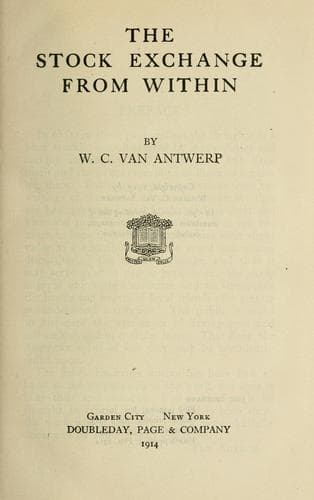
The Stock Exchange from WithinVan Antwerp, William C. (William Clarkson)
History
The Stock Exchange from Within
Van Antwerp, William C. (William Clarkson)
New York Stock Exchange; Stock exchanges
The management and control of a great public business, especially
one that has long survived public criticism, is no light matter. It
requires more than common industry, and more than common ability. What
the Stock Exchange asks of you and of every thoughtful citizen in the
land is a recognition of these matters, and a patient survey of all
that enters into them. The critic in “The Vicar of Wakefield” laid it
down as a good rule that you should _always_ say the picture would have
been a better one if the artist had taken more time. Criticism offered
in this spirit the members of the Stock Exchange can bear with good
humor. What hurts them on the raw is the critic’s failure to study and
investigate, or, getting back to the text of Mr. Bryce’s sermon, “the
neglect to think.”
CHAPTER VI
PANICS, AND THE CRISIS OF 1907
A panic is a state of mind. It cannot be regulated by statute law
nor preached down by press or pulpit. At such times, suspicion,
apprehension, and alarm take possession; reflection and sobriety
are crowded out; men do and say irrational and unreasoning things;
incidents trifling in themselves are exaggerated into undue
proportions; all kinds of difficulties are conjured into the
imagination. The best that can be said of such a phenomenon is that it
is of brief duration.[59]
In Wall Street, where men are accustomed to looking forward at all
times, the question is ever in mind as to the next panic. The last one
left its sting; we are interested now in knowing about the future.
Have we learned how to avoid these difficulties? May we hope to
diminish their force and mitigate their terrors? May we rely upon the
superior organization of business and the greater quantity and quality
of capital to soften the effect of the next shock? I think not. We
may lull ourselves into a coma of fancied security as we reflect upon
experience and its expensive lessons, but we deceive ourselves if we
think that we shall finally arrive at a point where these convulsions
shall cease.
Nothing of that sort can come about among people strong with health
and vigor, confident and full of energy, and impatient for action.
With such a people life is incessantly mobile; a constantly increasing
volume of creative activity impels them onward. Panics are unknown
in dead countries and in countries that have not yet heard the call
of progress; in all other countries the violence of these shocks is
directly proportionate to the enterprise of the people. The more
civilization there is, the greater the creation of wealth; the more
wealth there is, the greater the volume of speculation that creates
wealth. In such circumstances it is idle to talk of a time when panics
shall cease, because confidence and enterprise must ever push onward,
speculation in material things must accompany them, supply must
overtake demand, and human nature with its moods and caprices must
finally pay toll.
Public-domain text, read in full here on John Shaqi.
Reviews
Reviews
No reviews yet
Be the first to share your thoughts on this work.
Elsewhere in the archive
Join the Discussion
Join the discussion
Sign in to leave a comment or review.
Sign InorCreate an account