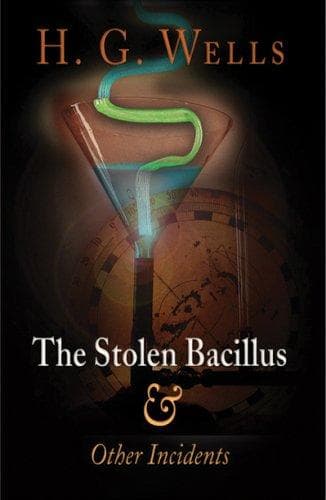
The Stolen Bacillus and Other IncidentsWells, H. G. (Herbert George)
Science
The Stolen Bacillus and Other Incidents
Wells, H. G. (Herbert George)
Science fiction, English; Short stories, English
It was perhaps as effectual a reply as he could make under the
circumstances, and largely turned the current of feeling against
Hapley. The very people who had most gleefully cheered on those
gladiators became serious at the consequence. There could be no
reasonable doubt the fret of the defeat had contributed to the death
of Pawkins. There was a limit even to scientific controversy, said
serious people. Another crushing attack was already in the press and
appeared on the day before the funeral. I don't think Hapley exerted
himself to stop it. People remembered how Hapley had hounded down his
rival, and forgot that rival's defects. Scathing satire reads ill over
fresh mould. The thing provoked comment in the daily papers. This it
was that made me think that you had probably heard of Hapley and this
controversy. But, as I have already remarked, scientific workers live
very much in a world of their own; half the people, I dare say, who go
along Piccadilly to the Academy every year, could not tell you where
the learned societies abide. Many even think that Research is a kind
of happy-family cage in which all kinds of men lie down together in
peace.
In his private thoughts Hapley could not forgive Pawkins for dying.
In the first place, it was a mean dodge to escape the absolute
pulverisation Hapley had in hand for him, and in the second, it left
Hapley's mind with a queer gap in it. For twenty years he had worked
hard, sometimes far into the night, and seven days a week, with
microscope, scalpel, collecting-net, and pen, and almost entirely with
reference to Pawkins. The European reputation he had won had come as
an incident in that great antipathy. He had gradually worked up to a
climax in this last controversy. It had killed Pawkins, but it had
also thrown Hapley out of gear, so to speak, and his doctor advised
him to give up work for a time, and rest. So Hapley went down into a
quiet village in Kent, and thought day and night of Pawkins, and good
things it was now impossible to say about him.
At last Hapley began to realise in what direction the pre-occupation
tended. He determined to make a fight for it, and started by trying to
read novels. But he could not get his mind off Pawkins, white in the
face, and making his last speech--every sentence a beautiful opening
for Hapley. He turned to fiction--and found it had no grip on him.
He read the "Island Nights' Entertainments" until his "sense of
causation" was shocked beyond endurance by the Bottle Imp. Then
he went to Kipling, and found he "proved nothing," besides being
irreverent and vulgar. These scientific people have their limitations.
Then unhappily, he tried Besant's "Inner House," and the opening
chapter set his mind upon learned societies and Pawkins at once.
Public-domain text, read in full here on John Shaqi.
Reviews
Reviews
No reviews yet
Be the first to share your thoughts on this work.
Elsewhere in the archive
Join the Discussion
Join the discussion
Sign in to leave a comment or review.
Sign InorCreate an account