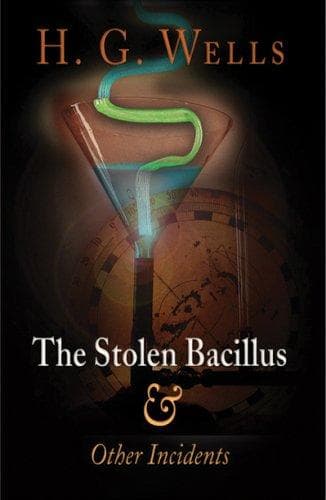
The Stolen Bacillus and Other IncidentsWells, H. G. (Herbert George)
Science
The Stolen Bacillus and Other Incidents
Wells, H. G. (Herbert George)
Science fiction, English; Short stories, English
One thing was very clear to him. His landlady could not possibly
understand about the strange moth, especially as he had failed to
catch it. No one but an entomologist would understand quite how he
felt. She was probably frightened at his behaviour, and yet he failed
to see how he could explain it. He decided to say nothing further
about the events of last night. After breakfast he saw her in her
garden, and decided to go out to talk to her to reassure her. He
talked to her about beans and potatoes, bees, caterpillars, and the
price of fruit. She replied in her usual manner, but she looked at him
a little suspiciously, and kept walking as he walked, so that there
was always a bed of flowers, or a row of beans, or something of
the sort, between them. After a while he began to feel singularly
irritated at this, and to conceal his vexation went indoors and
presently went out for a walk.
The moth, or butterfly, trailing an odd flavour of Pawkins with it,
kept coming into that walk, though he did his best to keep his mind
off it. Once he saw it quite distinctly, with its wings flattened out,
upon the old stone wall that runs along the west edge of the park,
but going up to it he found it was only two lumps of grey and yellow
lichen. "This," said Hapley, "is the reverse of mimicry. Instead of
a butterfly looking like a stone, here is a stone looking like a
butterfly!" Once something hovered and fluttered round his head, but
by an effort of will he drove that impression out of his mind again.
In the afternoon Hapley called upon the Vicar, and argued with him
upon theological questions. They sat in the little arbour covered with
briar, and smoked as they wrangled. "Look at that moth!" said Hapley,
suddenly, pointing to the edge of the wooden table.
"Where?" said the Vicar.
"You don't see a moth on the edge of the table there?" said Hapley.
"Certainly not," said the Vicar.
Hapley was thunderstruck. He gasped. The Vicar was staring at him.
Clearly the man saw nothing. "The eye of faith is no better than the
eye of science," said Hapley, awkwardly.
"I don't see your point," said the Vicar, thinking it was part of the
argument.
That night Hapley found the moth crawling over his counterpane. He sat
on the edge of the bed in his shirt-sleeves and reasoned with himself.
Was it pure hallucination? He knew he was slipping, and he battled
for his sanity with the same silent energy he had formerly displayed
against Pawkins. So persistent is mental habit, that he felt as if it
were still a struggle with Pawkins. He was well versed in psychology.
He knew that such visual illusions do come as a result of mental
strain. But the point was, he did not only _see_ the moth, he had
heard it when it touched the edge of the lampshade, and afterwards
when it hit against the wall, and he had felt it strike his face in
the dark.
Public-domain text, read in full here on John Shaqi.
Reviews
Reviews
No reviews yet
Be the first to share your thoughts on this work.
Elsewhere in the archive
Join the Discussion
Join the discussion
Sign in to leave a comment or review.
Sign InorCreate an account