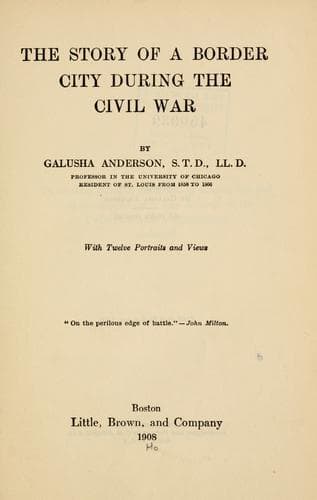
The story of a border city during the Civil WarAnderson, Galusha
History
The story of a border city during the Civil War
Anderson, Galusha
Missouri -- History -- Civil War, 1861-1865; Saint Louis (Mo.) -- History -- Civil War, 1861-1865
One of my own deacons, a true and brave man, at first hesitated as to
the stand he ought to take. With him it was a matter of conscience. He
was not swayed by any sordid motive. His associations had been largely
with Southern and pro-slavery men. He regretted that I had felt impelled
to speak from my pulpit for the Union. But when asked by some of his
secession brethren to sign a petition to which I have already referred,
asking me to resign my pastorate, he began earnestly to think what he
ought to do. He said to those that solicited him to put his name to that
petition, “I have never yet openly opposed any one of my pastors; and
even now, while I regret that our present pastor publicly discussed a
political question, I cannot sign this petition without careful
consideration. I wish to take it home with me to-night, and pray over
it, before I decide what to do in reference to it.” He prayed. He
determined not to sign it. He began to think as never before. He now
observed that all the newspapers and journals that came to his house
were pro-slavery and secession; and he decided to secure for daily
reading some that presented the opposite view. He at once subscribed for
two Union papers. He looked over his library and did not find a book in
it that was antagonistic to slavery. He went at once to a bookstore and
bought three anti-slavery books, which he carefully read. Within a few
days his mind was completely revolutionized. He had decided what to do.
Every fibre of his being was for the Union. He soon called me into his
office and said: “Pastor, you made one serious mistake. You ought to
have preached against secession at least three months before you did.”
And the good deacon was undoubtedly right. From that time all measures
taken for the preservation of the Union seemed to him to be dilatory. He
chafed because the President held back his emancipation proclamation.
After the war was over, St. Louis sent him to Washington as one of its
representatives. But we should not forget how much such a decision made
in that time of political upheaval cost him. It may seem easy to us now,
but it tried the soul then. It broke up old associations, and for a time
at least made lifelong friends enemies.
Public-domain text, read in full here on John Shaqi.
Reviews
Reviews
No reviews yet
Be the first to share your thoughts on this work.
Elsewhere in the archive
Join the Discussion
Join the discussion
Sign in to leave a comment or review.
Sign InorCreate an account