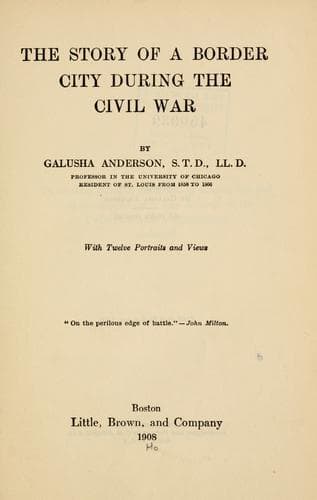
The story of a border city during the Civil WarAnderson, Galusha
History
The story of a border city during the Civil War
Anderson, Galusha
Missouri -- History -- Civil War, 1861-1865; Saint Louis (Mo.) -- History -- Civil War, 1861-1865
Living on the same square with myself was a man of Southern birth. He
was a pleasant, agreeable gentleman. I held him in high esteem. I had
been called by him to minister in his household in a time of sickness
and death. Tenderness of feeling had marked our intercourse in those sad
days. He and I had never exchanged a word on the subject of secession.
Still, one morning as I met him and as usual saluted him, he did not, as
he had been wont to do, return my salutation. I concluded that, absorbed
in something else, he did not see me. I could not believe that his
seeming discourtesy was intended. Two or three days after, I greeted him
again, but obtained from him no sign of recognition. I determined not to
give up my friend without one more effort. A week later I met him on the
sidewalk near his own door, stood within four feet of him, looked him
straight in the face, and said, “Good morning,” calling him by name; but
he made no response either by word or look. He was no longer my friend,
but my enemy. Why? He had learned from others that I was for the
Union,—that was the explanation of his rudeness. During all the war we
frequently met, but passed each other as though we were walking,
insensate posts. I always felt a strong impulse to speak once more, but
I checked it, lest speaking might give to my dumb neighbor useless
offence. Such experiences as this were peculiar to those who lived in a
border city during the war of the rebellion.
But the open alignment of men and women in our city for or against the
Union, disturbed, if it did not destroy, in many of our churches the
Christian fellowship that had hitherto existed. Where the membership of
a church was politically very largely of the same mind, the friction
arising from the few in opposition, while deplorable, did not very
seriously interfere with its general harmony. In such a case the small
minority either remained and held its peace, or else withdrew noisily or
quietly, while the main body of the church, freed from irritation and
unified, continued its legitimate work with increased power and
efficiency. But where the members of a church were about equally divided
on the great national issue their contention sometimes became
acrimonious. When such conflict was waged, brotherly love was
overwhelmed, and the very existence of the church itself was imperilled.
I well knew one such church. It occupied, in the northern part of our
city, a very important field for aggressive Christian work, but by its
internal dissensions its influence for good was neutralized. It was of
course no wonder that they were absorbed in the gigantic national battle
then being waged. Not only the most vital political interests were at
stake, but a great moral question was submitted to the arbitrament of
the sword. These Christian men and women were irresistibly impelled to
take sides. Some of them were fighting for the Union and against
slavery; others against the Union and for slavery. They were all honest
Public-domain text, read in full here on John Shaqi.
Reviews
Reviews
No reviews yet
Be the first to share your thoughts on this work.
Elsewhere in the archive
Join the Discussion
Join the discussion
Sign in to leave a comment or review.
Sign InorCreate an account