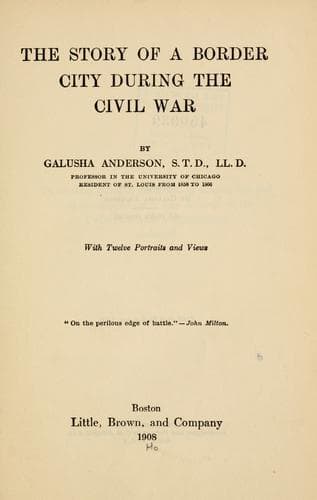
The story of a border city during the Civil WarAnderson, Galusha
History
The story of a border city during the Civil War
Anderson, Galusha
Missouri -- History -- Civil War, 1861-1865; Saint Louis (Mo.) -- History -- Civil War, 1861-1865
How can the acts of this Virginia slaveholder be explained? Why did he
deal kindly with his slaves? What led him to make such great pecuniary
sacrifices in manumitting them? The explanation is probably in part to
be found in the benevolent disposition with which God had endowed him;
but in addition to this he was a genuine Christian. He was vitally
united to Christ. Christ was in him and he had the Spirit of Christ. He
was living the life of Christ. He had much of Christ’s love to his
fellow men. He never for a moment doubted the manhood of his slaves, and
he felt impelled by the spirit within him to treat them as his fellow
men. He was a constant reader of the Bible. He had, I think, the
best-thumbed New Testament in my entire congregation, and the truths of
the gospel were antagonistic to slavery. He evidently very profoundly
believed what the great apostle to the Gentiles wrote: “There is neither
bond nor free: for we are all one in Christ Jesus.”
A few months after I made my home in St. Louis, my good deacon wished me
to go with him a few miles out of the city and call upon Captain Harper,
one of his close friends. He did not tell me the real reason why he
wished me to make the captain a visit, but thereby hangs an interesting
tale. On a beautiful autumn day, we drove out to the farmhouse of his
friend. We were welcomed with genuine Southern hospitality. After a few
moments conversation under the shade-trees in front of the house, Mr.
Brotherton said, “I think that you would enjoy a walk over the farm with
Captain Harper.” To this I eagerly assented. The farm appeared to be in
perfect order; the fences were well built, the fields were thoroughly
tilled, and the maturing crops were abundant. It was the best kept farm
that it had been my lot to see up to that time in my adopted State.
There were several hundred acres of it. Here and there in different
directions I saw on the farm neat cottages painted white. I asked the
captain what they were. He told me that they were occupied by German and
Irish families, the families of the men who worked his farm. “A few
years ago,” he said, “I carried on this plantation by slave labor. I had
twenty-one slaves. But one day as I was walking across this field, where
we now are, the thought came to me for the first time in my life that my
slaves had the same right to themselves and to the product of their
labor, that I had to myself and the product of my toil. And this
conviction was strong and persistent; I could not shake it off. But what
could I do with my slaves? The laws of the State were such that if I
should give them their freedom they would be worse off than in their
bondage. I then thought of the Colonization Society and decided to free
my slaves, and, if I could get their consent, to send them to Liberia. I
called them all together one day in my dooryard, and told them that I
had been convinced that I had no just right to them or to their labor;
Public-domain text, read in full here on John Shaqi.
Reviews
Reviews
No reviews yet
Be the first to share your thoughts on this work.
Elsewhere in the archive
Join the Discussion
Join the discussion
Sign in to leave a comment or review.
Sign InorCreate an account