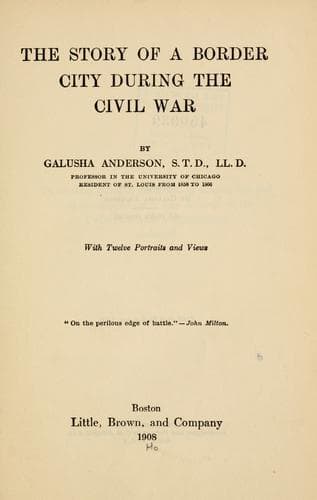
The story of a border city during the Civil WarAnderson, Galusha
History
The story of a border city during the Civil War
Anderson, Galusha
Missouri -- History -- Civil War, 1861-1865; Saint Louis (Mo.) -- History -- Civil War, 1861-1865
Both parties to the rapidly developing national conflict were ably and
fittingly represented in the conference. The Unionists felt that their
interests, identical with the national interests, would be wisely
guarded by General Lyon, Colonel Blair and Major Conant. General Lyon
opened the conference, stating that it would be conducted on the side of
the Union by Colonel Blair, than whom no one was better equipped for the
responsible task. But as the deliberations between these men of
irreconcilable views proceeded, Lyon, who had profoundly studied the
underlying questions and principles that divided the Federals and the
Confederates, and was by nature aggressive and inclined to disputation,
gradually assumed the part of leader in that momentous interchange of
views, while Mr. Blair lapsed into silence, a satisfied and admiring
listener. State and national sovereignty there met face to face. They
were opposites. Both could not be true. Hours passed in seeking some
basis of agreement, but none was found. So long as each party held his
view unflinchingly, there could be no common standing ground. Colonel
Blair, afterwards speaking of the conference, declared that he said
little or nothing, and did not need to; that General Lyon, in the most
thorough and lucid manner, analyzed every proposal submitted by the
Governor, pointed out every subterfuge and held up to the light every
fallacy. The main contention of the secessionists was that the United
States had no right to organize and arm Home Guards, nor to send troops
into, and to occupy, the territory of sovereign Missouri; if General
Lyon would agree to these vital propositions, on other grounds they were
willing for the sake of peace to make what seemed to them great and
humiliating concessions. But what they asked no loyal officer of the
United States army would or could grant. So, after the conference had
lasted nearly five hours, and all the views presented had been
thoroughly discussed, Lyon closed this memorable, crucial debate by
saying: “Rather” (he was still seated and spoke deliberately, slowly and
with peculiar emphasis) “rather than concede to the State of Missouri
the right to demand that my government shall not enlist troops within
her limits, or bring troops into the State whenever it pleases, or move
its troops at its own will into, out of, or through the State; rather
than concede to the State of Missouri for one single instant the right
to dictate to my government in any matter however unimportant, I would”
(rising as he said this, and pointing in turn to every one in the room)
“see you, and you, and you, and you, and you, and every man, woman and
child in the State dead and buried.” Then turning to the Governor, he
said: “This means war. In an hour one of my officers will call for you
and conduct you out of my lines.” And then, without another word,
without an inclination of the head, without even a look, he turned upon
Public-domain text, read in full here on John Shaqi.
Reviews
Reviews
No reviews yet
Be the first to share your thoughts on this work.
Elsewhere in the archive
Join the Discussion
Join the discussion
Sign in to leave a comment or review.
Sign InorCreate an account