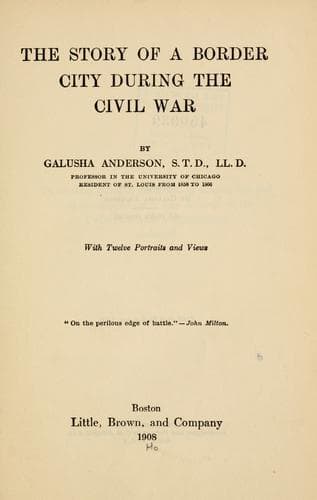
The story of a border city during the Civil WarAnderson, Galusha
History
The story of a border city during the Civil War
Anderson, Galusha
Missouri -- History -- Civil War, 1861-1865; Saint Louis (Mo.) -- History -- Civil War, 1861-1865
These requirements made and strictly enforced by martial law greatly
annoyed many, even among the loyal of the city and county, especially
elderly men and women, who had spent most of their lives in unrestrained
liberty of movement. To be compelled to solicit in person a permit from
the provost marshal to leave or enter the city seemed to them an
arrogant and galling invasion of their freedom. And while they bowed to
this inexorable demand so necessary to guard the fealty of their city
and State to the Union, it was a yoke to which they unwillingly
submitted, and under which they chafed.
I well remember meeting at that time a large, venerable man, who by a
multitude of people was affectionately called Father Welsh. He was a
pioneer Baptist minister. He had long lived in St. Louis County, and had
preached not only in churches, schoolhouses, and private residences, but
in summer in groves under the canopy of leafy boughs. He was not only
generally respected, but sincerely loved by very many who had been
blessed through his faithful, sympathetic ministrations. He was loyal to
his country. His patriotism was unqualified and ardent, but to him
martial law was abhorrent. He complained bitterly that one as old and
well known as he was should be compelled to solicit a pass from a United
States officer, in order that, unmolested by military sentinels, he
might enter and leave the city and county where he had so long
proclaimed the gospel. And he evidently represented many of unsullied
patriotism, who deeply felt the infringement of their accustomed
liberties. But in a border city, we were all compelled to learn by
experience the difference between a state of war and a state of peace.
But if martial law was so distasteful even to some of the truly loyal,
what was it to the men and women among us, who were aiding and abetting
those in rebellion against the Federal government? They could not take
the stringent oath printed on the pass, without which it could not be
granted to them. If they should undertake to get out of the city or
county without a pass, in all probability they would be challenged and
arrested by the military sentinels, and, unable to take any oath of
allegiance, would be duly landed in durance vile. Rather than run such
risks, most of them, muttering their indignant protests, sat down in
their homes and sulkily waited for deliverance. But the kind of
deliverance that they ardently longed for happily never came.
Public-domain text, read in full here on John Shaqi.
Reviews
Reviews
No reviews yet
Be the first to share your thoughts on this work.
Elsewhere in the archive
Join the Discussion
Join the discussion
Sign in to leave a comment or review.
Sign InorCreate an account