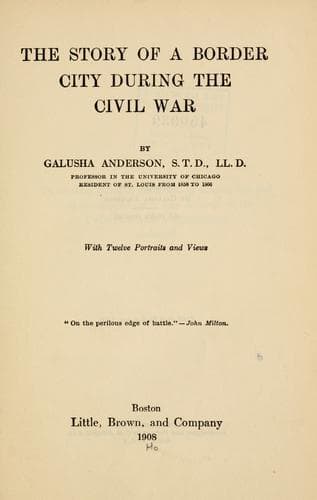
The story of a border city during the Civil WarAnderson, Galusha
History
The story of a border city during the Civil War
Anderson, Galusha
Missouri -- History -- Civil War, 1861-1865; Saint Louis (Mo.) -- History -- Civil War, 1861-1865
that in attempting to do what in itself as a matter of merely abstract
justice was right, he was quite too impulsive, effusive, and
spectacular, and that he had clearly exceeded his authority. In fact he
was attempting to do what the general government felt itself debarred
from doing by constitutional law and by a late specific act of Congress.
[Illustration:
THE AUTHOR, GALUSHA ANDERSON, IN 1861, WHEN THE PASS WAS GRANTED HIM.
[_Page 218_
]
But Fremont’s career, as commander of the Western Department, now drew
rapidly to its close. He had gathered an army of twenty-five thousand
men; but when the brave Mulligan at Lexington, on the Missouri River, in
the western part of the State, was besieged by a rebel force more than
four times greater than his own, and yet fought on pluckily for days,
Fremont failed to re-enforce him. To be sure, he made what seemed to us
a rather belated and languid effort so to do, but the troops ordered by
him to Lexington failed to reach their destination before Mulligan was
compelled to surrender.[60] This was a blow so disastrous to the Union
cause, that the loyal of our city were filled with disappointment and
discontent. Some of them murmured their disapprobation of the commanding
general, some openly and bitterly denounced him. _The Evening News_, a
Union journal, in a strong, manly editorial, entitled “The Fall of
Lexington,” sharply criticized his failure to re-enforce Mulligan, and
for this criticism, the proprietor, Charles G. Ramsay, was arrested by
order of the provost marshal, taken to headquarters and there examined
by the military authorities. He was sent to prison, and his paper was
suppressed. All the manuscript in his office was seized and the
building, where his paper was published, was put into the possession of
a provost-guard.[61] With very few dissenting voices, this invasion of
the freedom of the press was sharply condemned by Union men. The
occurrence added largely to the distrust of the capacity of the general
for a command so large and difficult.
Public-domain text, read in full here on John Shaqi.
Reviews
Reviews
No reviews yet
Be the first to share your thoughts on this work.
Elsewhere in the archive
Join the Discussion
Join the discussion
Sign in to leave a comment or review.
Sign InorCreate an account