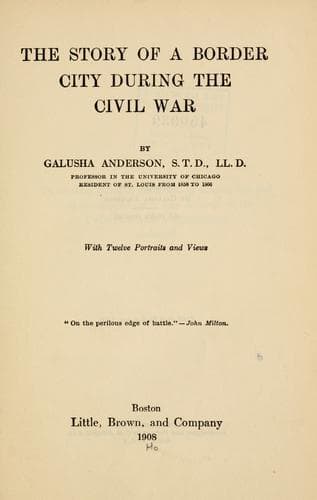
The story of a border city during the Civil WarAnderson, Galusha
History
The story of a border city during the Civil War
Anderson, Galusha
Missouri -- History -- Civil War, 1861-1865; Saint Louis (Mo.) -- History -- Civil War, 1861-1865
At last, during the closing days of September, Fremont and his army,
attended, as it seemed to us, with inextricable confusion and
indescribable clatter, left St. Louis for Jefferson City. No armed host
ever went forth to battle made up of nobler men. The best blood of the
West ran in their veins. They were unusually intelligent and patriotic.
Price, apparently always unwilling to risk a doubtful conflict,
abandoning his project of destroying the railroads in the northern part
of the State, with an army of about twenty thousand men, retreated in
orderly fashion towards southwest Missouri. The loyal of our city now
took new heart and hope. Our general, unopposed, moved on towards
Springfield. On the 25th of October, Zagonyi, with a hundred and fifty
of Fremont’s body-guard, made a brilliant dash into that city,
dispersing the rebel soldiers stationed there to defend it. Over this we
were exultant. The first brush with the enemy had resulted in decisive
victory and had added glory to our arms. The people of Springfield, with
tumultuous joy, ran up the Stars and Stripes in every part of their
city. Fremont’s army was now rapidly concentrated there. The enemy was
steadily falling back toward northwestern Arkansas. Victory for our
whole army seemed hovering near, ready to perch on our banners. Even if
our general had made mistakes, he was about to atone for them all by
utterly defeating the enemy; so loyal St. Louis felt.
But while this apparently auspicious campaign was being prosecuted, not
a few leading men, headed by Colonel Frank P. Blair, were urging the
authorities at Washington to remove Fremont from his command. Mr. Blair
was evidently bent on securing this end. He preferred formal charges
against the general,[62] in which he accused him of conduct unbecoming
an officer and a gentleman, extravagance and waste of the public moneys,
despotic and tyrannical conduct, and disobedience of orders. These
charges he sustained by many specifications. While Mr. Blair’s onslaught
seemed not wholly destitute of heat and partisanship, it contained so
much of truth that the authorities at Washington felt that they could
not ignore it. It also greatly disturbed the loyal of our city and
divided them into opposing parties, some for, some against, the general.
Public-domain text, read in full here on John Shaqi.
Reviews
Reviews
No reviews yet
Be the first to share your thoughts on this work.
Elsewhere in the archive
Join the Discussion
Join the discussion
Sign in to leave a comment or review.
Sign InorCreate an account