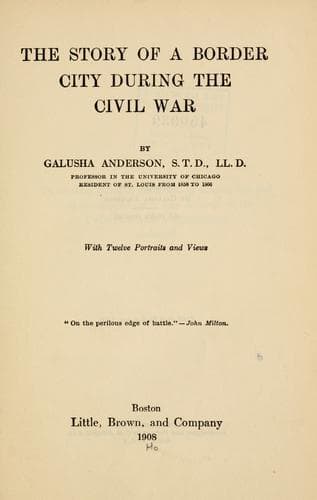
The story of a border city during the Civil WarAnderson, Galusha
History
The story of a border city during the Civil War
Anderson, Galusha
Missouri -- History -- Civil War, 1861-1865; Saint Louis (Mo.) -- History -- Civil War, 1861-1865
When the Secretary arrived at Washington and made his report, the
removal of Fremont from his command soon followed. He was apprised of it
on November 2d,[68] and immediately took leave of his army. To most of
us, this seemed at the moment a calamity. Not that we could justly find
fault with the decision reached by the government, but we keenly felt
that the time for promulgating this decision was most inopportune. The
general was apparently on the eve of a great battle; his army glowed
with enthusiasm; the prospect of complete victory was unusually bright;
he had in fact, with the smallest modicum of fighting, nearly driven the
rebel army from our State. The strong, instinctive feeling of the great
body of loyal men and women of our city was that he ought to have had
the chance to finish the campaign so auspiciously begun. But the
authorities at Washington had, with apparently abundant justification,
decreed otherwise. There was only one thing to be done; that was to
submit without murmuring.
By the removal of Fremont his patriotic army was greatly disheartened.
Some of them, in the first flush of disappointment, declared that they
would not serve under another leader; that when he left they would throw
down their arms and return to their homes. But in his farewell address
to his troops, Fremont rose above all personal resentment, and in a
tender patriotic appeal exhorted them to be as faithful to his successor
as they had been to him.[69] Their sober second thought responded to his
manly, unselfish words, and, in spite of their personal attachment to
him, sinking all individual preferences, they determined unswervingly to
fight on for the Union under any general that might be placed over them.
So, as we generally anticipated, the highest motive prevailed.
Fremont returned to St. Louis. The loyal Germans, to whom we and the
whole country owed so much, received him with unshaken confidence, and
with the warmest expressions of affection. At the time they were firmly
convinced that those who had so strenuously urged his removal had
treated him with marked injustice. These tokens of personal loyalty and
confidence touched his heart. In response to the assurances of his
steadfast friends, he complained of the unjust charges that, in his
absence, had been “rained on his defenceless head—defenceless because
his face was turned to the public enemy.” But, though smarting under
what he deemed grievous personal wrong, there was no note of recreancy
to his country.
Public-domain text, read in full here on John Shaqi.
Reviews
Reviews
No reviews yet
Be the first to share your thoughts on this work.
Elsewhere in the archive
Join the Discussion
Join the discussion
Sign in to leave a comment or review.
Sign InorCreate an account