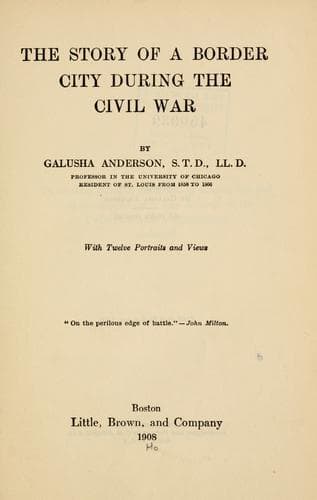
The story of a border city during the Civil WarAnderson, Galusha
History
The story of a border city during the Civil War
Anderson, Galusha
Missouri -- History -- Civil War, 1861-1865; Saint Louis (Mo.) -- History -- Civil War, 1861-1865
to the defunct Governor, was solemnly voted out by his defunct
legislature. The secession State government manifestly died hard. Even
its expiring spasms were comical. Its proclamations and legislative acts
were wild and futile. Rather than to have committed such folly it would
have been better “to be a dog, and bay the moon.” And all the loyal of
Missouri looked on and laughed.
But the action of our officeless Governor flowed out of his agreement
with the Confederate authorities at Richmond. Three days after Jackson
declared the sovereign independence of Missouri, the Confederate
Congress authorized Jefferson Davis to raise troops in Missouri for the
Southern army, and to establish recruiting stations to facilitate this
work; and on the 19th of August voted to admit Missouri into the
Southern Confederacy, when, by her legally constituted authority,—the
authority being the overturned State government,—she shall have ratified
the constitution of the Confederate States.[77] This act of the
Confederate Congress was duly approved by President Davis.[78]
This hostile legislation at Richmond was followed by a proclamation of
General Price at Springfield, on the 21st, declaring all Missouri Home
Guards enemies of the Southern Confederacy, and that they would be
treated as such. What the general proclaimed was unquestionably true,
what he threatened was expected. However, all that transpired at
Richmond we did not at that time know fully. We got some inkling of it;
just enough to stimulate our imaginations, and to spur us to greater
vigilance and to unremitting effort to keep Missouri true to the general
government. We well knew that the seceded States would do their utmost
to secure her for the Confederacy; that St. Louis was the key of the
situation; that it was the objective point of every movement of the
State Guards,[79] and of every invading army from the South, and that
our position would not be secure until the battle for the Union had been
fought to a finish. Hence all military movements within our borders, all
armed conflicts great and small, all secret plottings of the disloyal,
all acts of the Convention or of the defunct legislature, all
proclamations, hostile or friendly, demanded and received our
unremitting, earnest attention. By midsummer of 1861, all loyal citizens
of St. Louis had fully made up their minds that adhesion to the Union,
and security in it, were to be purchased only by the price of eternal
vigilance.
CHAPTER XVI
HALLECK AND HIS MANIFESTOES
Public-domain text, read in full here on John Shaqi.
Reviews
Reviews
No reviews yet
Be the first to share your thoughts on this work.
Elsewhere in the archive
Join the Discussion
Join the discussion
Sign in to leave a comment or review.
Sign InorCreate an account