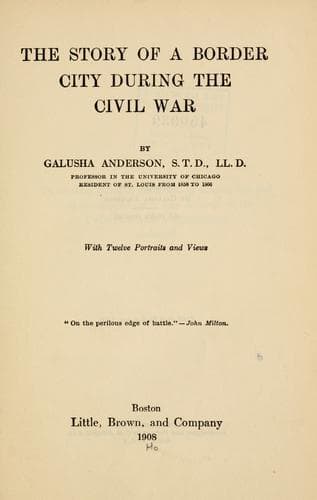
The story of a border city during the Civil WarAnderson, Galusha
History
The story of a border city during the Civil War
Anderson, Galusha
Missouri -- History -- Civil War, 1861-1865; Saint Louis (Mo.) -- History -- Civil War, 1861-1865
On the 9th of April I met General Quinby at the levee, as he was taking
a steamer to go down the Mississippi. He was with General Halleck, with
whom I conversed, and with whom I was most favorably impressed. While
few fully approved of all his measures, he had been a godsend to the
Unionists of the city. He had done his duty faithfully and fearlessly.
He had held an extremely difficult position. He had been compelled at
times to listen to many diverse opinions, yet had never been confused as
to what he deemed wise and just. His decisions had been clear. He had
carried them out promptly and thoroughly. He had, to be sure,
unwittingly sown dragon’s teeth whose harvest tormented some of his
successors in command; but if he had shown as much wisdom in the field
as he did in our city and State, he would have made himself immortal.
But when he went down the river to take personal command of the army, he
apparently left his wisdom behind him.
CHAPTER XVII
REFUGEES
In the preceding chapter we pointed out the manner in which General
Halleck, by forced assessments, compelled the more wealthy of the
disloyal of St. Louis to assist in caring for the refugees among us.
This suggests our varied experiences in dealing with these unfortunates
that, during the whole period of the war, came flocking in upon us, not
only from Missouri, but also from regions farther south. When General
Grant, by his masterful campaign, had swept all obstructions from the
Mississippi River, and opened up western Kentucky, western Tennessee,
Mississippi, Alabama, Arkansas, and northern Texas, poor whites and
negroes, freed by the onward march of our victorious army, fled, in
ever-increasing numbers, from all that conquered territory, to our city.
They came on government transports, came by boat-loads, sent by Union
generals because they had become a serious impediment to military
movements; they came also in wagons and carts of wonderful make, and in
large numbers on foot. St. Louis was for them a city of refuge.
But to set forth clearly the problem that was thrust upon us by their
coming, we must separate the heterogeneous multitude that appealed to us
for charity into homogeneous classes. We certainly cannot justly affirm
the same things of them all. Here, as elsewhere in society, we found
different and interesting types.
Public-domain text, read in full here on John Shaqi.
Reviews
Reviews
No reviews yet
Be the first to share your thoughts on this work.
Elsewhere in the archive
Join the Discussion
Join the discussion
Sign in to leave a comment or review.
Sign InorCreate an account