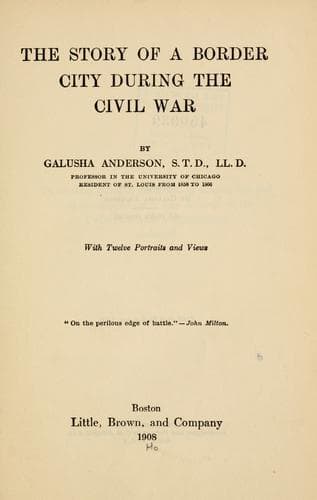
The story of a border city during the Civil WarAnderson, Galusha
History
The story of a border city during the Civil War
Anderson, Galusha
Missouri -- History -- Civil War, 1861-1865; Saint Louis (Mo.) -- History -- Civil War, 1861-1865
But the saddest result of the ruthless guerrilla campaign was the
shutting up for many months of the common schools in nearly every county
of the State. Such a calamity was measureless. And while our city
schools were undisturbed, we keenly sympathized with our fellow-citizens
in the State, and learned anew that, in what was of highest worth, we
were kin.
CHAPTER XX
CHARCOALS AND CLAYBANKS
In our hot fight for Missouri and the Union we unhappily split up into
factions. We not only contended against secession but against each
other. And the warring factions were significantly named Charcoals and
Claybanks. The Charcoals taken as a whole were uncompromising radicals,
while the Claybanks were the conservatives. Many of the Claybanks had
been born and educated in the North, while some of the blackest of the
Charcoals had been reared in the midst of slavery. They were recent
converts to Unionism and gloried in their new-found faith.
What gave birth to these party names no one can certainly tell.
Apparently, like Topsy, they “just growed.” The clay of Missouri is of a
decidedly neutral tint. Perhaps an extremist, indignant at a
conservative for his colorless views, called him a claybank; and since
the name was descriptive, fitting, and easily understood by Missourians,
it stuck. The conservative, stung by the epithet, may have warmly
retorted, “You are a charcoal.” And that name, equally descriptive and
fitting, also stuck. At all events each faction named the other, and
each adopted the name hostilely given and gloried in it. And for many
months these names bandied by the opposing factions played an important
part in the heated controversies of our State.
Both Charcoals and Claybanks were loyal to the Federal government. Upon
the main issue, the preservation of the Union, they agreed; but they
were at swords’ points upon the statement of the problem in hand and the
method of its solution. The Claybanks contended that the foremost
question was the maintenance of the Union. They were ready to preserve
it either with or without slavery. So their cry was: “Let us first save
the Union, and afterwards adjust the matter of slavery.”
Public-domain text, read in full here on John Shaqi.
Reviews
Reviews
No reviews yet
Be the first to share your thoughts on this work.
Elsewhere in the archive
Join the Discussion
Join the discussion
Sign in to leave a comment or review.
Sign InorCreate an account