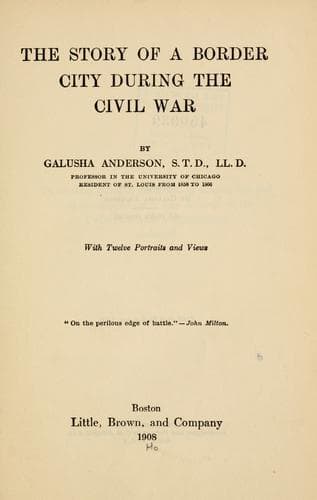
The story of a border city during the Civil WarAnderson, Galusha
History
The story of a border city during the Civil War
Anderson, Galusha
Missouri -- History -- Civil War, 1861-1865; Saint Louis (Mo.) -- History -- Civil War, 1861-1865
The extreme policy of General Curtis soon brought him into collision
with our conservative, provisional Governor. The sparks flew. The
Charcoals and Claybanks put on fresh war-paint. The one upheld the
general and his radical policy; the other the Governor and his more
moderate policy. While both parties were for the Union, they denounced
each other in the hottest terms. If we had believed what both factions
declared, we should have been forced to conclude that there was scarcely
a decent man among all the Unionists in the State. Each party again and
again appealed to the President for his support, but of course he could
not side with either. At last, worn out by this incessant strife, in
May, 1863, he removed General Curtis from his command and put General
Schofield in his place.
On May 24th, the new commander began his work. He was not a stranger to
us. Before the war he had been for several months professor of physics
in Washington University, which adorned our city, and was highly
esteemed by all who knew him. Nor was he unfamiliar with this military
department, having been put in command of it for a time by General
Halleck. During his brief administration at that time he did such
thorough and heroic work that we all expected of him wise, liberal,
patriotic service, and were not disappointed.
Three days after he had relieved General Curtis, the President wrote him
a letter, which is so quaint and so packed with good sense that we feel
impelled to reproduce it. It tersely portrays the difficult task that
confronted him.
“EXECUTIVE MANSION, WASHINGTON,
“May 27, 1863.
“GENERAL J. M. SCHOFIELD:
“MY DEAR SIR:—Having relieved General Curtis and assigned you to the
command of the Department of Missouri, I think it may be of some
advantage for me to state to you why I did it. I did not relieve General
Curtis because of any full conviction that he had done wrong by
commission or omission. I did it because of a conviction in my mind that
the Union men of Missouri, constituting, when united, a vast majority of
the whole people, have entered into a pestilent factional quarrel among
themselves—General Curtis, perhaps not from choice, being the head of
one faction, and Governor Gamble that of the other. After months of
labor to reconcile the difficulty, it seemed to grow worse and worse,
until I felt it my duty to break it up somehow; and as I could not
remove Governor Gamble, I had to remove General Curtis. Now that you are
in the position, I wish you to undo nothing merely because General
Curtis or Governor Gamble did it, but to exercise your own judgment and
_do right_ for the public interest.
Public-domain text, read in full here on John Shaqi.
Reviews
Reviews
No reviews yet
Be the first to share your thoughts on this work.
Elsewhere in the archive
Join the Discussion
Join the discussion
Sign in to leave a comment or review.
Sign InorCreate an account