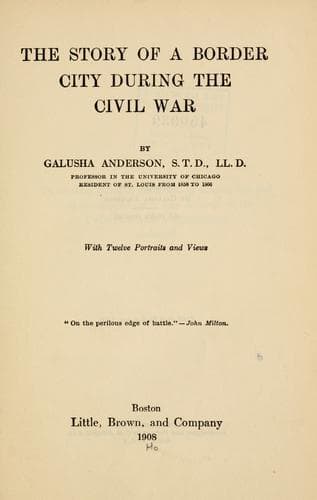
The story of a border city during the Civil WarAnderson, Galusha
History
The story of a border city during the Civil War
Anderson, Galusha
Missouri -- History -- Civil War, 1861-1865; Saint Louis (Mo.) -- History -- Civil War, 1861-1865
No one can measure the good done through the manifold appliances of that
Home. During the war over seventy thousand soldiers enjoyed its
hospitality. There they were helped over rough places; their
difficulties that seemed to them like mountains vanished; they were
nursed into strength and took on new heart and hope; became in fact new
men, and very many of them went back into the ranks, courageously to
fight to the finish the battle for the preservation of the Union.
Early in 1862 the Sanitary Commission also opened a Home on Elm Street,
for refugees, of which we have already spoken in a previous chapter; and
still another in 1863. These Homes were conducted on the same general
principles as the Home for soldiers. A man of great excellence of
character, Mr. Cavender, out of his deep sympathy for the forlorn
refugees, voluntarily gave his entire time to the care of them. Thus the
demand for loving, self-sacrificing toil for others always seemed to be
met by some unselfish soul like his.
But the care of the needy among us was not for a moment left to chance
volunteers. Not long after the Commission began its work, the Ladies
Union Aid Society was formed. It was made up of the best and most
efficient women of the city. Social distinctions were for the time being
obliterated. The hearts of the rich and the poor were united by the
common danger and by a common love of country. Any one who could do some
useful service to suffering soldiers was welcomed by all. This society
enlisted women, in different parts of the city, who met regularly in
groups to prepare such comforts as were needed by our brave boys both in
camp and hospital. It had its ramifications in all the loyal churches.
Without a thought of denominational distinctions, patriotic women of all
creeds or of no creed met to work for the armed defenders of the Union.
They freely donated the material that they prepared for use. They
scraped lint, knit socks, made under-garments, furnished beds for the
sick in hospitals, and secured aid and employment for the wives of
soldiers.
Out from the ranks of these women came many of our most efficient
hospital nurses. Miss Dix, by whom, or by some deputy of hers, all
nurses must be approved, had appointed as her agent in St. Louis, Mr.
Yeatman, president of the Sanitary Commission. On account of his
position he had unusual opportunities for observing among volunteer
helpers those best qualified for stated and official service, and his
selections were eminently wise.
No one could be a candidate for this honor unless she was between
twenty-five and fifty years old, had good health, and was cheerful in
disposition, without frivolity. And her official entrance upon the work
of nursing hardly robbed her of the blessing of gratuitous patriotic
service, since the compensation was twelve dollars a month and her keep.
How does that strike a professional nurse of to-day?
Public-domain text, read in full here on John Shaqi.
Reviews
Reviews
No reviews yet
Be the first to share your thoughts on this work.
Elsewhere in the archive
Join the Discussion
Join the discussion
Sign in to leave a comment or review.
Sign InorCreate an account