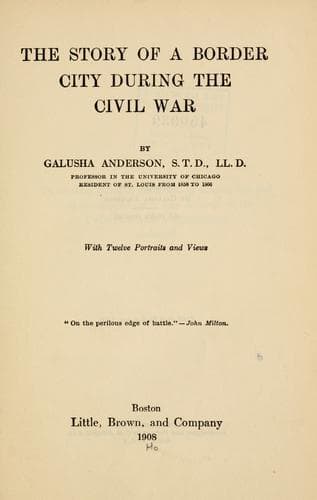
The story of a border city during the Civil WarAnderson, Galusha
History
The story of a border city during the Civil War
Anderson, Galusha
Missouri -- History -- Civil War, 1861-1865; Saint Louis (Mo.) -- History -- Civil War, 1861-1865
I met in that hospital a Confederate soldier from one of the western
counties of Arkansas. His name was Anderson. He had small, shining black
eyes, peeping out from under black eyebrows; long, heavy, black
whiskers, unkempt and begrimed, needing the cleansing power of soap and
water; thick, shocky black hair that hung down to his shoulders, and was
as coarse as the hair on a horse’s tail. When I first saw him I had a
strong desire to have a talk with a man so peculiar and who bore my
surname. While he could neither read nor write, I found him intelligent
on all matters pertaining to his county, but about things outside of his
own immediate neighborhood, he knew next to nothing. He never had been
away from home before. Having been taken prisoner, he was compelled to
travel. Contrary to his will he had begun to see more of the world. But
he was absolutely sure that the “Yanks” had begun the “wicked war.” He
informed me, that the North first fired on the South. Nor could I
convince him of his error. He was ignorant, and a hot Southerner. His
under jaw was square and each ropy hair springing out of his tawny scalp
looked as though it were clinched on the inside of his skull. A face so
strange and strong, I can never forget.
A few days later, in the same hospital, I was urgently asked by a man
about thirty-five years of age to help him solve a question of
conscience. He was a Quaker by birth and conviction. He had imbibed with
his mother’s milk the notion that war was prohibited by the commandment,
“Thou shalt not kill.” By education it had been interwoven with all his
thinking. But having at the same time a great abhorrence of human
bondage, when, in his neighborhood, scores of men were enlisting to
fight a Confederacy, the corner-stone of which had been boastfully
declared to be African slavery, the doctrine that war was murder sank so
completely into the background that, for a time, he became quite
unconscious of it. Aflame with patriotism, along with his neighbors, he
volunteered to fight the enemies of the Union. Then came the long,
toilsome days of military drill, and the march southward to meet the foe
in battle. He had much time for thought. As he reflected, the conviction
that no war is justifiable, which, for a season, had been submerged,
came up out of the depths of his subconsciousness and reasserted itself.
He began to feel utterly out of place. He had taken a solemn oath to do
what his conscience utterly forbade. He was in deep distress. There was
no one to whom he could unbosom himself. He was among thousands of his
countrymen, but felt absolutely alone. His regiment was ordered into
battle. For hours with his comrades in arms he loaded and fired; but he
could not shoot at his fellow men, so he shot into the air above their
heads. But this was a violation of his oath. And after the battle was
over and he had been sent to this hospital, what he had done tortured
him. Conscience pierced him for having broken his oath as a soldier,
Public-domain text, read in full here on John Shaqi.
Reviews
Reviews
No reviews yet
Be the first to share your thoughts on this work.
Elsewhere in the archive
Join the Discussion
Join the discussion
Sign in to leave a comment or review.
Sign InorCreate an account