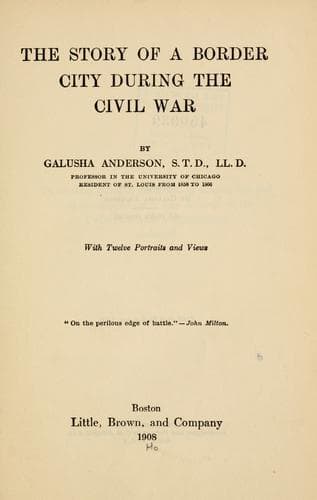
The story of a border city during the Civil WarAnderson, Galusha
History
The story of a border city during the Civil War
Anderson, Galusha
Missouri -- History -- Civil War, 1861-1865; Saint Louis (Mo.) -- History -- Civil War, 1861-1865
Now all this our general had quietly ferreted out. The knowledge
acquired by his skilful manipulation was of vast importance not only to
our city and State, but also to the general government. All the evidence
pertaining to this secret organization was carefully written out and
transmitted to President Lincoln. It covered one thousand pages of
foolscap.
But at first only a very few of the loyal of St. Louis, and, in fact, of
the nation, had any definite knowledge of the existence of this secret,
insidious foe. The great mass of our fellow-citizens stood in blissful
ignorance over a destructive mine, that might at any moment be exploded.
But thanks to our general, the President and his counsellors knew it
more perfectly than heretofore. He made known what he had recently
discovered to a few in our city in whom he reposed special confidence.
He also revealed it to his most trusted lieutenants. And what was
all-important to us, he knew the facts of the whole case probably more
thoroughly than any loyal man in the nation. And this knowledge shaped
every order that he issued and inspired his most weighty acts.
It was still necessary to garrison all parts of the State. Those in
command of the garrisons were instructed to keep the sharpest possible
watch of all whose loyalty was suspected; to break up all rendezvous of
such men wherever found; to permit no illicit gatherings of
secessionists, and to deprive of arms all who expressed sympathy with
the rebellion. Thus the general laid a strong, repressive hand upon “The
Knights of the Golden Circle” in our State. And before our story ends we
shall see how wise such action was.
Evidently with his eye on this secret fraternity of the disloyal, that a
little later he so fully unearthed, on March 1st, he forbade any one to
take negroes from the State, but demanded that by every legitimate
method they should be encouraged to enlist as soldiers. He declared that
in all such enlistments the property rights of the master would be
guarded; the government would compensate him for his chattels, but the
slaves by their enlistment would become freemen. The general felt that
he should soon need, to circumvent any threatened disloyal uprising, as
many soldiers as he could secure, whether they were white or black.
Public-domain text, read in full here on John Shaqi.
Reviews
Reviews
No reviews yet
Be the first to share your thoughts on this work.
Elsewhere in the archive
Join the Discussion
Join the discussion
Sign in to leave a comment or review.
Sign InorCreate an account