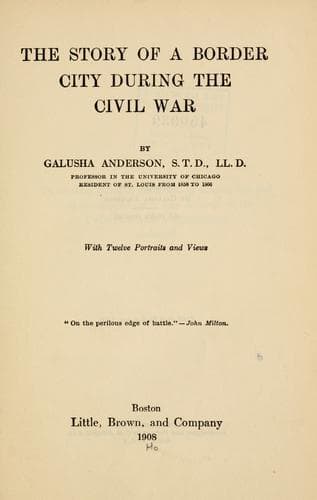
The story of a border city during the Civil WarAnderson, Galusha
History
The story of a border city during the Civil War
Anderson, Galusha
Missouri -- History -- Civil War, 1861-1865; Saint Louis (Mo.) -- History -- Civil War, 1861-1865
The leader of a band of guerrillas, by the name of Anderson, ordered his
gang to shoot into, and stop, a train of cars on the North Missouri
Railroad. In one of the coaches he found twenty-two unarmed United
States soldiers that, on account of sickness, had been furloughed. They
were on their way to their homes and loved ones. He ordered them all out
of the car, robbed them, stood them in a row and shot them. Some of the
bodies he scalped, others he put across the track and ran the engine
over them. He afterwards attacked a hundred and twenty men of the 39th
Missouri Volunteer Infantry, and having stampeded their horses, shot
every one of them in cold blood. A few days later he was recognized by
General Price as a Confederate captain, and with the gentle admonition
that he must behave himself, was sent out to destroy railroads.[111]
But this carnage went on. It was the culmination of horrors in Missouri.
All the barbarism that had gone before was now eclipsed. No other State
of the South was so harried by lawless, irresponsible armed men. They
did not wage war, and were entitled to none of the amenities of war as
conducted by civilized nations.
In St. Louis we were as yet safe. But we breakfasted and supped on
horrors. Our hearts bled for our suffering brethren in the State. We did
what we could to help them; but we were able to effect very little. The
persistent rumors that a large army of invaders would soon sweep into
our State from the South made us apprehensive that there might at no
distant day be fighting at our own gates.
At last these rumors of invasion were followed by the ingress of a
veteran rebel force under the command of General Price. They came up
from Arkansas. On the 24th of September, General Shelby, one of Price’s
division commanders, with five thousand men and several pieces of
artillery, was reported as just south of Pilot Knob, about eighty-five
miles from St. Louis. It was the vanguard of an army of at least fifteen
thousand men.
Excitement ran high among us. We had no force at all adequate to our
protection. As we have already seen, most of the soldiers in and around
St. Louis had been sent to the front. Of this state of things, the rebel
general had undoubtedly been informed. He expected to capture our city,
and, comparatively defenceless as we were, we thought that his
expectation would probably be realized; at all events, we could not see
why it should not be. Still we all deeply felt that we must do our
utmost to save that for which we had so successfully contended for more
than three years.
Public-domain text, read in full here on John Shaqi.
Reviews
Reviews
No reviews yet
Be the first to share your thoughts on this work.
Elsewhere in the archive
Join the Discussion
Join the discussion
Sign in to leave a comment or review.
Sign InorCreate an account