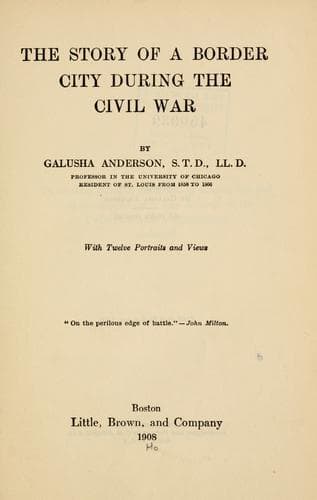
The story of a border city during the Civil WarAnderson, Galusha
History
The story of a border city during the Civil War
Anderson, Galusha
Missouri -- History -- Civil War, 1861-1865; Saint Louis (Mo.) -- History -- Civil War, 1861-1865
“‘I, A. B., do solemnly swear, that I am well acquainted with the terms
of the third section of the second Article of the Constitution of the
State of Missouri, adopted in the year eighteen hundred and sixty-five,
and have carefully considered the same; that I have never, directly or
indirectly, done any of the acts in said section specified; that I have
always been truly and loyally on the side of the United States against
all enemies thereof, foreign and domestic; that I will bear true faith
and allegiance to the United States, and will support the Constitution
and laws thereof, as the supreme law of the land, any law or ordinance
of any State to the contrary notwithstanding; that I will, to the best
of my ability, protect and defend the Union of the United States, and
not allow the same to be broken up and dissolved, or the Government
thereof to be destroyed or overthrown, under any circumstances, if in my
power to prevent it; that I will support the Constitution of the State
of Missouri; and that I make this oath without any mental reservation or
evasion, and hold it to be binding on me.’”
We see from this how intensely in earnest were the delegates of this
Convention. But this oath was not wholly a creation of theirs. It had a
gradual growth. We have seen with what imperativeness General Halleck
demanded an oath of allegiance of all officers of the State, county and
city, without which they were not permitted to exercise their functions.
The generals of the department that came after him rigorously maintained
the same policy. The first sovereign Convention adopted it and
strenuously enforced it by the sword. This Convention, receiving it from
the first, with wonderful genius for probing the conscience, elaborated
it. Under its manipulation the oath became retrospective, introspective
and prospective. No man could take it without perjury, who by word or
act had been in the past, was in the present, or should be in the
future, disloyal to the government of the United States. It not only
prohibited one who could not subscribe to it from voting, but also from
holding any government office of whatever grade, teaching in any school
or preaching the gospel. And to make sure that the fountains of justice
should be freed from every suspicion of disloyalty, the Convention
vacated the offices of the judges of the Supreme Court, circuit and
county courts, and special courts of record throughout the State, and of
all clerks of courts, county recorders, and circuit attorneys and their
assistants, and “empowered and directed” the Governor of the State to
fill these offices so vacated by his appointment. Since most judges and
subordinate officers of the courts were unable to subscribe to the oath
of loyalty without perjury, the Convention was determined that court
officials should be appointed that could. And thinking it unsafe to wait
for the slow process of a popular election and probably fearing, if they
Public-domain text, read in full here on John Shaqi.
Reviews
Reviews
No reviews yet
Be the first to share your thoughts on this work.
Elsewhere in the archive
Join the Discussion
Join the discussion
Sign in to leave a comment or review.
Sign InorCreate an account