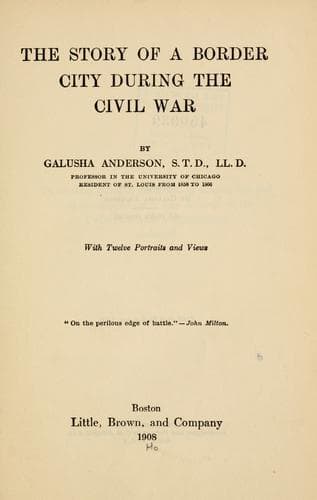
The story of a border city during the Civil WarAnderson, Galusha
History
The story of a border city during the Civil War
Anderson, Galusha
Missouri -- History -- Civil War, 1861-1865; Saint Louis (Mo.) -- History -- Civil War, 1861-1865
“Charcoals and Claybanks,” 276–287, 341, 342;
radical and conservative Unionists, 277–278;
differences among, 278;
extreme policy of Charcoals, 280–282;
Charcoals oppose General Schofield and Governor Gamble, 283–284;
complain to War Department, 285;
Claybanks favor and oppose General Schofield, 287.
Chicago Convention nominates Abraham Lincoln, 54–55.
Chickamauga, battle of, 315.
Chouteau, Colonel, house of, back from river, 7.
Christian secessionists, 140–141.
Church, see “Pulpit,” “Baptist,” “Presbyterian.”
City General Hospital, 290.
City Hospital, 288.
“City of Alton,” steamer, engaged to carry arms, 77–80.
“City of Louisiana,” fitted as a hospital, 297.
Civil government in Saint Louis inaugurated, 7.
“Claybanks,” see “Charcoals and Claybanks.”
Clayton, Honorable A. M., of Alabama, 119.
Clubs, political, 19–22;
see “Wide-Awakes” and “Minute Men.”
Colonization Society, 175.
Columbus, Kentucky, fugitives from panic flee to, 111;
rebels at, plan to seize Paducah, 223;
Union army there first, 245.
Committee of Safety, 92–93.
Committee on Federal Relations, of Convention of 1861, 53, 49;
reports against secession, 57.
Conant, A. J., unveils Lincoln’s portrait, 366.
Conant, Major, in conference with Lyon and Jackson, 199.
Confederacy, Southern, 71, 82, 87, 105, 119, 147;
formed, 62;
Congress of, votes to admit Missouri, 232;
authorizes Jefferson Davis to raise troops in Missouri, 232.
Confiscation, of war material in Saint Louis, 116;
of the “J. C. Swan,” 118;
of slaves, 218;
by General Curtis, 280.
Constitution of Missouri, new, of 1865, 349, 356;
ratified at polls, 357;
portion of, declared unconstitutional, 359.
Convention of Missouri of 1861, how created, 41–42;
met in Jefferson City, 42–43;
adjourned to Saint Louis, 45;
its composition, 46–48;
pro-slavery in sentiment, 48;
divided on how to preserve slavery, 49;
conditional and unconditional unionists in, 50–52;
organization of, 53;
speech in, by Orr, 54;
action of, on Georgia’s Ordinance of Secession, 55;
opposed by legislature, 56;
sovereign in Missouri, 57, 231;
voted down secession, 58;
adjourned to meet on call of Committee, 58;
came together in July, 227;
established provisional state government, 228;
sustained by Halleck, 235;
required oath of allegiance, 235.
Convention, Radical, of 1865, 342–359;
calling of, 342;
composition of, 343–344;
met in Mercantile Library Hall, 343;
a German as president of, 344;
passed Emancipation Ordinance, 345–346;
made drastic requirements for the franchise, 349–352;
adopted “Oath of Loyalty,” 351–353;
amended the constitution, 349–352, 360–361;
rejoicing in, over Lee’s surrender, 360;
adjourned sine die, April 10, 361.
Cooper, William, commissioner from Alabama, 23.
Crum, Mr., candidate for Congress, 5.
Public-domain text, read in full here on John Shaqi.
Reviews
Reviews
No reviews yet
Be the first to share your thoughts on this work.
Elsewhere in the archive
Join the Discussion
Join the discussion
Sign in to leave a comment or review.
Sign InorCreate an account