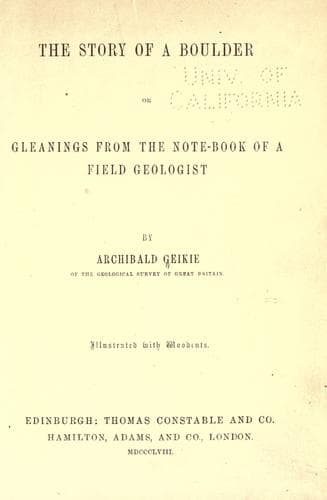
The Story of a Boulder; or, Gleanings from the Note-book of a Field GeologistGeikie, Archibald
Science
The Story of a Boulder; or, Gleanings from the Note-book of a Field Geologist
Geikie, Archibald
Geology; Petrology
The internal bones of the holoptychius were of great size and strength,
as befitted such a bulky ganoid. Some of them had a singular style of
surface ornament, that somewhat resembled a frosted widow on a December
morning. Their internal structure was loose and cancellated; the endo-
being usually of a less compact texture than the exo-skeleton. Judging
from the size of such bones, the carboniferous holoptychius must have
been one of the bulkiest and most formidable denizens of the deep,
reaching sometimes to a length of twenty feet or even more. Such an
animal would have been, perhaps, quite a match for our hugest crocodile
or alligator, for it must have swum about with a litheness and agility
possessed by none of the saurian reptiles. Like that leviathan chosen
by the Almighty, in an age long subsequent, as an illustration of His
power and greatness, the holoptychius must have been king over all
the inhabitants of the sea, and the magnificent language of Job,
descriptive of the living animal, applies not less graphically to
the extinct one: "Who can open the doors of his face? his teeth are
terrible round about. His scales are his pride, shut up together as
with a close seal. One is so near to another, that no air can come
between them. He maketh the deep to boil like a pot: he maketh the sea
like a pot of ointment. He maketh a path to shine after him; one would
think the deep to be hoary."
Our survey has hitherto been directed to the denizens of carboniferous
lake, river, and sea, and we have found them to be alike important in
numbers and interesting in organization. It is otherwise, however,
when we turn in search of the denizens of the carboniferous lands.
The crowded trees and shrubs of the coal strata recalling as they do
old forest-covered swamps, might seem to indicate the probability of
a pretty numerous terrestrial fauna. Where are we to look for the
fossilized relics of land animals, if not in the remains of a submerged
land-surface? And yet, strange as it may seem, of the inhabitants of
the land during the Coal-measure period we know almost nothing. "We
have ransacked hundreds of soils replete with the fossil roots of
trees,--have dug out hundreds of erect trunks and stumps, which stood
in the position in which they grew,--have broken up myriads of cubic
feet of fuel, still retaining its vegetable structure,--and, after
all, we continue almost as much in the dark regarding the invertebrate
air-breathers of this epoch, as if the coal had been thrown down in
mid-ocean."[50]
[Footnote 50: Sir Charles Lyell's _Elements_, fifth edition, p. 406.]
Public-domain text, read in full here on John Shaqi.
Reviews
Reviews
No reviews yet
Be the first to share your thoughts on this work.
Elsewhere in the archive
Join the Discussion
Join the discussion
Sign in to leave a comment or review.
Sign InorCreate an account