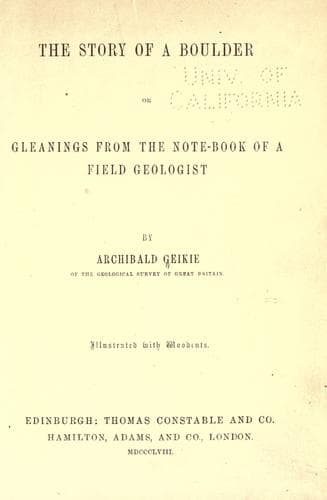
The Story of a Boulder; or, Gleanings from the Note-book of a Field GeologistGeikie, Archibald
Science
The Story of a Boulder; or, Gleanings from the Note-book of a Field Geologist
Geikie, Archibald
Geology; Petrology
In fine, then, no one can glance at a list of the carboniferous fauna
without perceiving either that the animated world of that ancient
epoch must have had a very different proportioning from what now
obtains, or that we have only a meagre and fragmentary record of it.
That the latter conclusion is the more philosophical will appear if we
reflect upon the many chances that exist against the entombment and
preservation of animal remains, especially of those peculiar to the
land. How very small a proportion of the remains of animals living in
our own country could be gathered from the surface-soil of any given
locality, and how very inadequate would be the meagre list of species
thus obtained, as representing the varied and extensive fauna of Great
Britain! In contrasting, then, the rich abundance of marine organisms
with the extreme paucity of terrestrial animals among the carboniferous
rocks, it would be too hasty to infer a corresponding disproportion
originally. It must be admitted that the rarity of air-breathers,
after such long-continued and extensive explorations among terrestrial
and lacustrine beds, presents a difficult problem, only (if at all)
to be cleared away by patient and persevering investigation. With
this preliminary caution, we may regard the carboniferous fauna as
peculiarly rich in marine species. The sea-bottoms swarmed with
stone-lilies, cup-corals, and net-like bryozoa, mingled with the
various tribes of molluscan life--the brachiopods with their long
ciliated arms; the bivalves and gastropods with their coloured shells
that recall some of the most familiar objects of our shores; and the
cephalopods with their groups of siphonated chambers, straight as in
the orthoceras, or gracefully coiled as in the goniatite. The seas
swarmed, too, with fishes belonging to the two great orders of ganoids
and placoids, the latter represented now by our sharks and rays,
though the exact type of the ancient genera is retained only by the
cestracion or Port-Jackson shark; the ganoids, with their strong armour
of bone, represented by but two genera, the lepidosteus of the American
rivers, and the polypterus of the Nile,--two fishes that seem but as
dwarfs when placed side by side with the gigantic holoptychius of the
coal-measures. The rivers and estuaries of the same period seem to have
been frequented by immense shoals of the smaller ganoidal fishes that
fed on decaying matter brought down from the land, and perhaps, too,
on the minute Crustacea that lay strewed by myriads along the bottom.
Into these busy scenes the bulkier monsters from the sea made frequent
migrations, perhaps in some cases ascending the rivers for leagues to
spawn, and returning again to their places at the mouth of the estuary
or in open sea. The rivers and lakes swarmed with small crustaceous
animals, and nourished, too, shells like those of our pearl-mussels.
The land--so luxuriantly clothed with vegetable forms--was hummed over
Public-domain text, read in full here on John Shaqi.
Reviews
Reviews
No reviews yet
Be the first to share your thoughts on this work.
Elsewhere in the archive
Join the Discussion
Join the discussion
Sign in to leave a comment or review.
Sign InorCreate an account