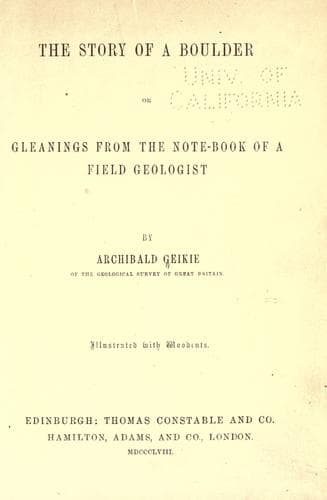
The Story of a Boulder; or, Gleanings from the Note-book of a Field GeologistGeikie, Archibald
Science
The Story of a Boulder; or, Gleanings from the Note-book of a Field Geologist
Geikie, Archibald
Geology; Petrology
and in conjuring up visions of earthquakes, and frightful abysses from
which there ever rose a lurid glare as hill after hill of molten rock
came belching up from the fires below. But while far from denying that
such appearances may have been sometimes seen during the long lapse
of the geological ages, and that they give no little vividness and
sublimity to a geological picture, we claim for the doctrine of the
tranquil and uniform operation during past time of existing laws and
forces, an element not less poetic. In the former case the pervading
idea is that of unlimited expenditure of power, in the latter that of
unlimited lapse of time. In the one case the action is Titanic but
transient, in the other it is tranquil but immensely protracted. The
two doctrines in this way counterbalance each other; yet I cannot but
think that however impressive it may be to stand in some lone glen, and
while gazing at its dark jagged precipitous cliffs, to dream about the
paroxysmal convulsions of some hour far back in the distant past, the
scene becomes yet more impressive when we look on its nakedness and
sublimity not as the sudden and capricious creation of a day, but as
the gradual result of a thousand centuries. These cliffs may once have
been low-browed rocks rising but a little way out of a broad grassy
plain, and serving as a noon-tide haunt for animals of long extinct
races. Thousands of years pass away and we see these same rocks higher
and steeper in their outline, brown with algæ and ever wet with surf,
while around them stretches a shoreless sea. Ages again roll on, and
we mark still the same rocks shooting up as bleak crags covered with
ice and snow. Another interval of untold extent elapses, and rock,
snow, and ice have all disappeared beneath a broad ocean cumbered
with ice-floes and wandering bergs. Again the curtain drops upon the
scene, and when once more it rises, the cliffs stand out in much the
same abrupt precipitous aspect with that which they now present, save
that their bald foreheads look less seamed and scarred than now, and
their dark sides show no trace of bush or tree. The white cascades that
to-day pour down from their summits and sides--seeming in the distance
like the white hairs of age--are insensibly deepening the scars and
furrows on these ancient hills, and thus slowly but yet surely carrying
on the process of degradation and decay. Musing on all this long
series of stages in the formation of one single cliff-line, is there
not something more sublime, something yet more impressive than if we
pictured but the chance random result of the gigantic paroxysm of an
hour?
Let us not be deterred then from seeking an explanation of the origin
of the ravine among some of the quieter and more unobtrusive forces
of Nature. Give them but an unlimited period to work in and they will
abundantly satisfy all our demands.
Public-domain text, read in full here on John Shaqi.
Reviews
Reviews
No reviews yet
Be the first to share your thoughts on this work.
Elsewhere in the archive
Join the Discussion
Join the discussion
Sign in to leave a comment or review.
Sign InorCreate an account