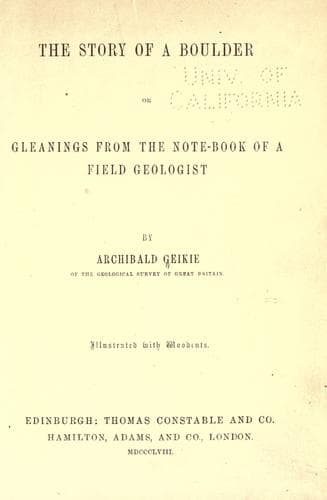
The Story of a Boulder; or, Gleanings from the Note-book of a Field GeologistGeikie, Archibald
Science
The Story of a Boulder; or, Gleanings from the Note-book of a Field Geologist
Geikie, Archibald
Geology; Petrology
[Footnote 55: Lyell's _Principles of Geology_. Ninth edition, p. 252.]
The alluvial matter deposited by the Rhone at its entrance into the
Lake of Geneva suffers perhaps no change when it once reaches the
bottom. Layer after layer accumulates tranquilly, without disturbance
from surface currents or other causes, so that the renovating effects
of the stream have here every advantage. It is otherwise, however,
where a delta gathers at the mouth of a river upon the sea-margin.
There tides and currents are ever demolishing what the stream has
piled up. Often, too, owing to the prevalence of high winds from
seawards, the river is dammed up for leagues, and the waters of
the ocean encroach far on the delta, mingling in this way marine
remains with those that are fluviatile or terrestrial. But with these
modifications the process of delta-formation remains essentially the
same, both in lakes and at the sea. The vast quantities of sand and
gravel transported by rivers during the flood-season sink to the bottom
as soon as the motion of the water will permit. This takes place at
the shore, where eventually wide tracts of low alluvial land encroach
upon the sea, covered with marshes and overgrown with vegetation. A
section of any of these deltas, obtained in boring for water, shows a
succession of sands and clays, with occasionally a few calcareous beds
and quantities of peaty matter formed of vegetation either drifted
or that grew on the spot.[56] If, now, a sufficient amount of matter
were piled over these loose incoherent strata, they would eventually
become as hard and compact as any of our ordinary building stones. The
sand would subside into a firm compact sandstone; the clay, in like
manner, would consolidate into fissile shale; the peat would become
chemically altered into coal; the calcareous seams would take the form
of layers of limestone; while the leaves, twigs, branches, and trunks,
dispersed through all the beds, would get black and carbonized, so as
precisely to resemble the lepidodendra, calamites, stigmariæ, &c., of
the carboniferous rocks. And thus might a mass of fossiliferous strata,
thousands of feet deep and thousands of square miles in extent, be
amassed by the prolonged operation of a single river.
[Footnote 56: The structure of maritime deltas, especially their
relation to the growth and entombment of forests, will be more fully
alluded to in a subsequent chapter, when we come to inquire into the
origin of a coal-field.]
It often happens that a delta is prevented from extending further
seawards owing to the prevalence of some marine current that comes
sweeping along the coast-line and cuts away the accumulations thrown
down by the river. The sediment thus removed is often carried to great
distances, and eventually settles down as a fine mud along the floor of
the sea, entombing any fucoids, infusoria, shells, corals, fish-bones,
or other relics that may lie at the bottom.
Public-domain text, read in full here on John Shaqi.
Reviews
Reviews
No reviews yet
Be the first to share your thoughts on this work.
Elsewhere in the archive
Join the Discussion
Join the discussion
Sign in to leave a comment or review.
Sign InorCreate an account