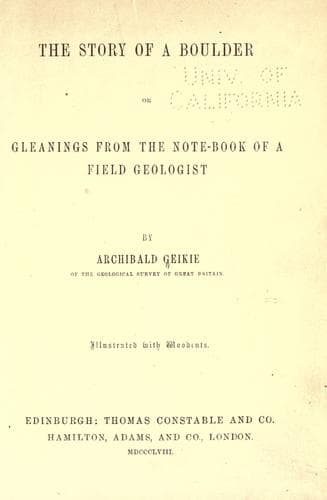
The Story of a Boulder; or, Gleanings from the Note-book of a Field GeologistGeikie, Archibald
Science
The Story of a Boulder; or, Gleanings from the Note-book of a Field Geologist
Geikie, Archibald
Geology; Petrology
stamp as undoubtedly of carboniferous age the rock which contains
them, whether it be sandstone or conglomerate, limestone or shale, and
whether we meet with it among the newly-raised blocks of the quarry,
or among the pebbles of the sea-shore. Each geological formation, I
repeat, beginning at the oldest known to us, and ending with those that
are still forming in our lakes and seas, has its own set of organic
remains whereby we can detect it wherever it may chance to occur, from
the equator to the poles. Each has its _style_, so to speak, just as
we can at once tell whether a drawing represents a Hindoo, Egyptian,
Assyrian, Greek, or Gothic temple, simply from the general _style_ of
the architecture.
Could we but voyage back in time as we can sail forward in space,
we should find each of the geological formations not less clearly
defined than are the different nations and countries of the present
day.[58] Were the reader suddenly set down in an out-of-the-way street
of Paris, he would probably not be long in discovering that he stood
on French ground. Or if spirited away in his sleep he should awake on
the banks of the Nile, he would soon ascertain himself to be in the
land of the Ptolemies. And so if you transported a geologist blindfold
into a quarry where ammonites and belemnites abounded, mingled here
and there with bones of ichthyosaurs and plesiosaurs, he would tell
you at once that the quarry lay among liassic strata. Or if he were
placed in a ravine where the rocks on either hand displayed fern-stems,
lepidodendra, stigmariæ, and sigillariæ, he would tell you that the
surrounding district was one of carboniferous rocks, and that probably
at no great distance there might be found smoking engines and dozens
of coal-pits. Or could you set him down in some dark night upon a
wild coast-line, and show him, perchance by the flare of torch-light,
bones and scales of osteolepis, pterichthys, and dipterus, lying on
the rocks around, he would tell you that the grim crags which shot up
into the gloom were as ancient as the era of the Old Red Sandstone. In
any case the character of the rock would signify nothing, nor would
he care about the general features of the landscape, though these too
become important characteristics in certain cases. Show him but a few
recognisable fossils, and you give him, as it were, an "Open Sesame" to
which the rocks unfold their gates and reveal a store of wonders yet
more varied than those in the cave of Ali Baba.
[Footnote 58: See _ante_, pp. 31, 32, and the Table of Rocks at the end
of the volume.]
Public-domain text, read in full here on John Shaqi.
Reviews
Reviews
No reviews yet
Be the first to share your thoughts on this work.
Elsewhere in the archive
Join the Discussion
Join the discussion
Sign in to leave a comment or review.
Sign InorCreate an account